Friday, January 18, 2019

Protect Babies from Congenital CMV: Pass CMV Legislation--Share Fact Sheet with Policy Makers

Lisa Saunders, a mother who found out too late she was at risk for passing CMV to her unborn child, is seen here speaking at the Centers for Disease Control and Prevention in Atlanta in 2008.

What is cytomegalovirus (CMV)? 

ONE-PAGE CMV FACT SHEET 

Between 50% and 80% of adults in the U.S. are infected with CMV by 40 years of age. It is the leading viral cause of birth defects passed from mother to unborn baby (Carlson et al., 2010). Congenital (meaning present at birth) CMV can cause disabilities in unborn babies such as hearing and vision loss, mental impairment and cerebral palsy. Disabilities from congenital CMV "exceeds those from the fetal alcohol syndrome, spina bifida, and childhood infections..."(Boppana and Fowler, 2017). 

According to the CDC:

* Approximately 1 in 200 children is born with congenital CMV (cCMV) infection.
* One in five babies [4,000 babies annually] with cCMV infection will have long-term health problems (4 million annual births/200 born with cCMV/5 sick or long-term health problems = 4,000 disabled by cCMV).
Is this the “kitty litter” disease? No, that is toxoplasmosis, which causes fewer birth defects than cCMV (Lopez,et al., 2000).

How can CMV be avoided?
·         Wash hands often with soap and water for 15-20 seconds, especially after wiping runny noses, changing diapers, picking up toys, etc. If soap and water are not available, use alcohol-based hand gel.
·         Use soap and water or a disinfectant to clean hard surfaces that have been contaminated by secretions.
·         Don’t kiss young children on the lips or share food, drinks, or eating utensils with them.

Why don’t doctors warn women of childbearing age about congenital CMV?
Fewer than half (44%) of OB/GYNs surveyed reported counseling their patients about preventing CMV infection (ACOG, 2007).
  Don’t want to frighten their patients: "The list of things we're supposed to talk about during women's first visit could easily take two hours and scare them to death,” said OB-GYN Laura Riley, M.D., director of infectious disease at Massachusetts General Hospital in FitPregnancy magazine, June/July '08.
  In 2015, the American College of Obstetricians and Gynecologists (ACOG) stated that their patients will consider prevention guidelines difficult to implement—“especially if they are told not to kiss their toddlers on the mouth — a possible route of transmission.”(CMV Is a Greater Threat to Infants Than Zika, but Far Less Often Discussed, New York Times, 2016)

What can we do to protect our children from CMV? 
Educate the public! “Despite being the leading cause of mental retardation and disability in children, there are currently no national public awareness campaigns to educate expecting mothers about congenital CMV,” states Clinical Advisor articleEducate pregnant women to prevent congenital CMV” (2014). Pass a bill similar Utah’s H.B 81 (2013) requiring cCMV prevention education plus testing newborns for cCMV if they fail hearing screen tests so their families can be educated about early intervention services and treatment options. To test for CMV, a saliva or urine sample is collected from the newborn and sent to a laboratory.

Cost of a CMV bill? 
Example: in 2014, Connecticut put CMV prevention education at $40,000 first year. Newborn hearing tests are already required in CT (and most states) and insurance pays for CMV testing (estimated at $150) if baby fails the hearing screen.

What is the annual cost of caring for children disabled by cCMV in the U.S.?
$1.86 billion annually, with a cost per child of more than $300,000, is the estimated cost of congenital CMV to the US health care system” (Modlin, et al., 2004).

Annual cost of caring for children disabled cCMV by state? 
In 2016, 3,945,875 babies were born in U.S. with .1% disabled by cCMV = 3,945 babies.  In Connecticut in 2016, the annual cost of caring for children disabled by cCMV can be calculated at 36,015 births x .1% cCMV disabled = 36 babies X $300,000/year = $10,800,000 or over 10 million annually. 

Which women are at greatest risk for contracting CMV? 
According to the CDC, "People who have frequent contact with young children may be at greater risk of CMV infection because young children are a common source of CMV..."
1.      Parents of children in day-care centers are at increased risk for contracting CMV (Pass et al, 1986). “Almost all the babies that I see who have congenital CMV, there is an older toddler at home who is in daycare,” said Dr. Jason Brophy, a pediatric infectious disease specialist, in the Ottawa Citizen (Payne, 2018).
2.      Toddlers can spread CMV to each other, their child care providers and families. "Up to 70% of children ages 1 to 3 years in group care settings excrete the virus...With regard to child-to-staff transmission, studies have shown increased rates of infection with CMV in caregivers/teachers ranging from 8% to 20%” (Caring for Our Children, American Academy of Pediatrics (AAP), et al, revised 2017).
Women’s knowledge of CMV
Recent surveys show that most women have never heard of CMV (Doutre et al, 2016)—including child care providers (Thackeray and Magnusson, 2016). Many caregivers acknowledge using diaper wipes to clean, but diaper wipes do not effectively remove CMV from hands (Stowell et al., 2014).

Will it make a difference if women are educated on CMV prevention? 
Yes, according to the New York Times, “pregnant mothers shown a video and offered hygiene tips were much less likely to get CMV (5.9 percent) than those not given information on prevention (41.7 percent)” (Saint Louis, 2016). Five CMV prevention education studies published between 1993 and 2015 were analyzed in 2015: “In each report, the efficacy of hygienic precautions has been > 75%...” (Adler, 2015).

###

BARRIERS and SOLUTIONS to Getting CMV Legislation Passed 

By Lisa Saunders (LisaSaunders42@gmail.com) of Connecticut, CMV mom and  leader of Child Care Providers Education Committee, National CMV Foundation

What happened in Connecticut

January 2014:    HB 5147 was introduced-An Act Concerning Newborn Screening for Globoid Cell Dystrophy and Cytomegalovirus and Establishing A Public Education Program For CMV.  It passed the Public Health Committee and House, but was not voted on by the Senate before the close of session (first year cost of 40, 000 was a “deal breaker”).

January 2015:   HB 5525 CMV legislation proposed again. In March, Public Health Committee passed it after CMV education component was removed because of cost. In May, targeted newborn screening passed with bipartisan support.

BARRIERS TO GETTING LEGISLATION PASSED

·        CMV is unknown: Since legislators have never heard of CMV, they think if it was a problem, OB/GYNs would say so. 
·        Cost: What is a CMV testing law going to cost our state, citizens, and insurance companies?
·        Some doctors and Early Education Teachers/Child Care Leaders may not support bill: Some medical professionals oppose public policy and legislation mandating medical practice. The daycare industry may worry about frightening  away their workers.
·        Extra work: Some state departments and programs don’t want the extra work of providing CMV prevention education and training—especially if there is no funding for it. 
·        Finding legislators to introduce the bill: It is hard to introduce a bill on a problem very few have heard of. Legislators worry about getting enough support such as people testifying at the hearing, writing letters, calling legislators and visiting their offices. Many legislators don’t understand why just telling their their state to educate women doesn’t produce a real, lasting change in awareness. 

SOLUTIONS

Find an advisor to help guide you:  You may have connections to an organization eager and Corporate Affairs willing to help you.

Streamline educating legislators: Create a one-page CMV fact sheet  (see above) telling them what they quickly need to know to convince others. Provide a pocket folder that includes back-up documents such as the bills passed in other states (find them at www.nationalcmv.org/cmv-research/advocacy), the new CMV flyers from CDC:
 (Spanish/English), flyers/posters from the National CMV Foundation (so they see educational materials already exist), relevant newspaper articles and scientific studies.

Attract Media Attention: Give yourselves a name such as [your state name] CMV Advocacy Project. Create a Facebook page with your group name on it and complete the “About” section. Sent media releases to TV/radio/newspapers quoting doctors and parents. Send resulting links of coverage to all the legislators—you never know who will really care.

Get your state’s (or county’s) health department behind you: You may get resistance because it means work for them if it passes, but remind them that staff such as child care providers are at increased risk for CMV. Under the Occupational Safety and Health Act of 1970 (OSH Act), workers have the right to “receive information and training about hazards.”

Stress the Benefits: You may be apposing medical professional groups so you must articulate the benefits to legislators. According to Brenda K. Balch, MD, Connecticut's American Academy of Pediatrics (AAP) Early Hearing Detection and Intervention (EHDI) Chapter Champion, our CMV “testing protocol allows for a more timely diagnosis of the etiology of the infants hearing loss and is less expensive than imaging and genetic testing.” A CMV testing law will also “increase healthcare workers’ and parents’ awareness of CMV research and possible intervention strategies for congenital CMV.”

 UNDERSTAND THE LIMITS AND CONCERNS OF TARGETED NEWBORN SCREENING

·        In Connecticut, our law mandates testing only for infants who do not pass their hearing screening. Dr. Balch states, “We know that hearing loss may be late onset or progressive and therefore infants with a very mild hearing loss at birth or those with late-onset hearing loss due to CMV may be missed.
·        “After 3 weeks of age, the PCR for CMV on saliva and urine and the urine culture cannot differentiate between cCMV and CMV acquired postnatally.
·        “Breastfeeding in close proximity to the collection of the saliva sample may skew the results.
·        “There is no drug licensed to treat cCMV, although studies are ongoing using antivirals, such as ganciclovir and valganciclovir.”

Monday, January 14, 2019

CT Mom and Doctor Balch Collaborate to Prevent CMV Birth Defects

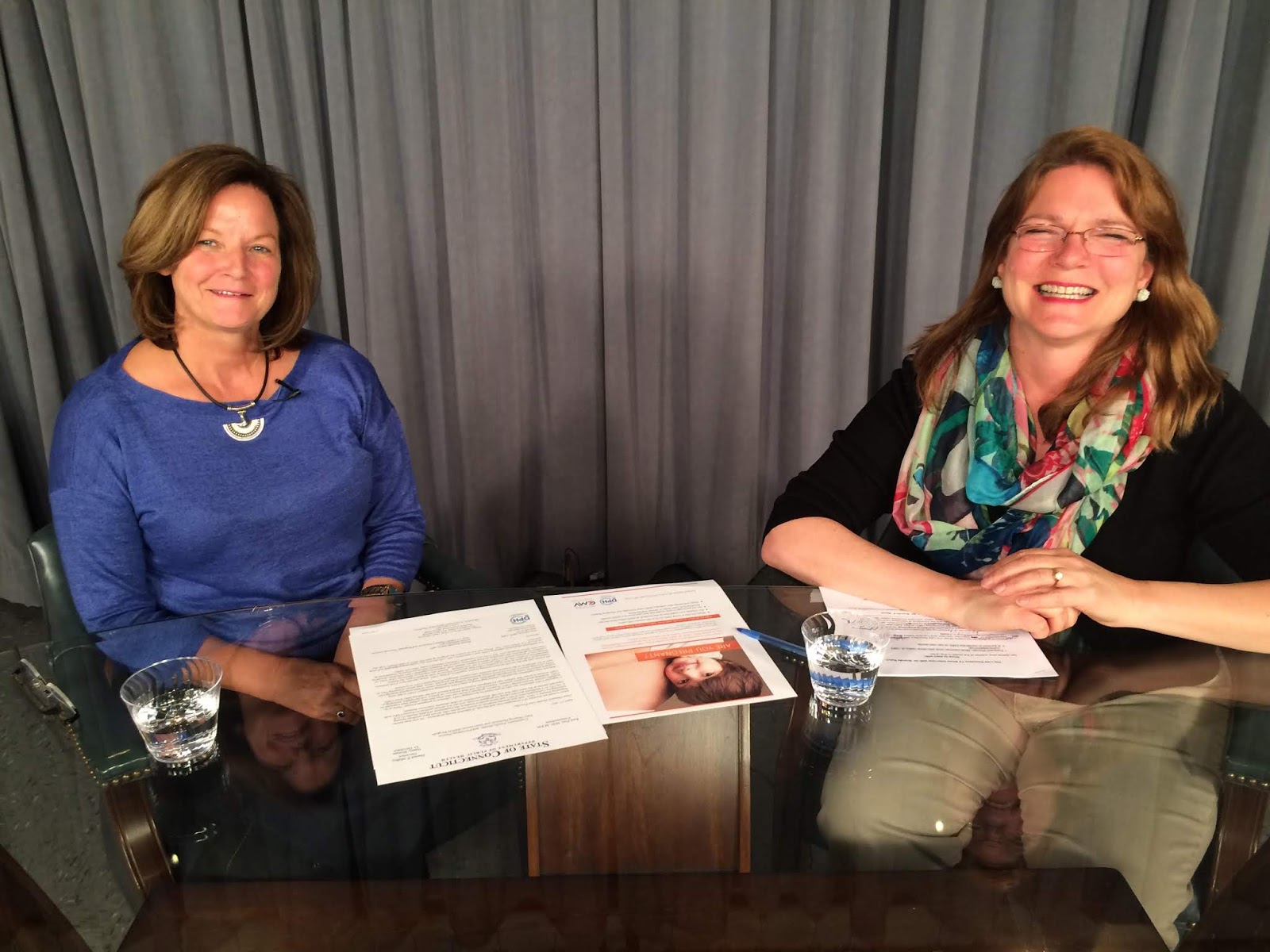
Dr. Brenda Balch (l) appeared on the Lisa Saunders Show in April 2017 to discuss Connecticut passing House Bill 5525: "An Act Concerning Cytomegalovirus [CMV].” To watch, click here  (Balch interview begins 9 minutes in after  the interview with CMV expert, Dr. Gail Demmler-Harrison, and CMV survivor, Caroline Bailey)

A Connecticut Pediatrician Continues Collaboration with Mother to Prevent Connecticut's #1 Birth Defect Virus, CMV

  • Brenda K. Balch, MD, Connecticut's American Academy of Pediatrics (AAP) Early Hearing Detection and Intervention (EHDI) Chapter Champion
  • Lisa Saunders of Mystic, Connecticut, mother of a girl born disabled by congenital CMV and leader of Child Care Providers Education Committee, National CMV Foundation


Mystic, Conn--I’m Lisa Saunders, a mother who didn’t know about cytomegalovirus (CMV) until my daughter, Elizabeth, was born severely disabled by congenital CMV in 1989. Ever since I met Dr. Brenda Balch in 2014, we have been collaborating to help prevent the kind of suffering Elizabeth endured for 16 years until her death in 2006. Dr. Balch has been the American Academy of Pediatrics (AAP) Early Hearing Detection and Intervention (EHDI) Connecticut Chapter Champion since 2006 and Regional Network Liaison for District I since 2015.

Dr. Balch was instrumental in helping me to get Connecticut to pass House Bill 5525: "An Act Concerning Cytomegalovirus”. She testified in Hartford and visited the capitol several times. In 2015, Connecticut became the second state to require newborns who fail their hearing screen be tested for CMV. Many healthcare professionals have since learned about CMV. 


Dr. Brenda K. Balch, CT’s American Academy of Pediatrics Early Hearing Detection and Intervention Chapter Champion (left), Casey Famigletti and Lisa Saunders, CMV mothers, testified in favor of CMV prevention education and testing newborns for CMV who fail their hearing screen in 2015. 

Ceremonial signing for Public Act 15-10: An Act Concerning Cytomegalovirus at the Office of Governor Dannel P. Malloy on July 28, 2015. (L to R): Jane Baird, Government Relations, Connecticut Children's Medical Center; Dr. Wallis Molchen, Chief Resident, Connecticut Children’s Medical Center; Jane Brancifort, Deputy Commissioner, Connecticut Department of Public Health; State Representative, John Hampton; Dr. Brenda K. Balch, American Academy of Pediatrics Early Hearing Detection and Intervention Chapter Champion; Lt. Governor Nancy Wyman; Lisa Saunders, parent rep, Congenital Cytomegalovirus Foundation, holding picture of daughter Elizabeth; Kevin Ryan, State Representative; Governor Dannel P. Malloy; Cathy Osten, State Senator; Ken Hiscoe, Pfizer, Government Relations; Jarred and his mother, Melvette Ruffin; DeVaughn Ward, Liaison, Department of Public Health; and Kinson Perry, lobbyist at Rome, Smith and Lutz.

Dr. Balch, a consultant for Connecticut Department of Public Health (CT DPH), helped DPH implement the law by:
1)     Creating CMV content for DPH website: https://portal.ct.gov/DPH/Family-Health/EHDI/CMV
2)     Revising the Hospital Service Delivery Flow Chart to reflect additional CMV steps
3)     Updating Connecticut’s hearing test brochure for families to include information on CMV testing and prevention.
Collaborating with DPH, Dr. Balch created:
·        Resource sheet for pediatric care providers, “The Role of the Primary Healthcare Provider in Cytomegalovirus Screening” and “Follow Up Recommendations and Monitoring.”
·        Fact Sheet for OB/GYNs and a Parent brochure, both emphasizing CMV prevention:
o   Worked with the National CMV Foundation to add the CT DPH logo to “Are You Pregnant” National CMV Awareness Flyer.

In September 2018, I filmed Dr. Balch briefly commenting on how the Connecticut CMV testing law was implemented and the data received to date since the CMV testing law went into effect in 2016. To watch it, click here (CMV Public Health and Policy Conference, Burlington, Vermont). 

Dr. Balch continues to educate the public about CMV, particularly child care providers who are unaware of their occupational hazard. She co-authored a study with doctoral students of audiology at the University of Connecticut entitled, "National Child Care Provider's Awareness of Congenital Cytomegalovirus”. To help me in my CMV efforts, she:

  • Appears on TV with me to discuss CMV.
  • Accompanied me to visit a local child care director and their consulting nurse to discuss CMV and how to educate their workers.
  • She actively creates educational materials as a member of the Child Care Providers Education Committee, National CMV Foundation, which I lead.
  • Co-authored my poster, "Increasing Child Care Provider Awareness of Congenital Cytomegalovirus (CMV)" for the CMV Public Health and Policy Conference, Vermont (September 2018): 


Lisa Saunders and Dr. Brenda K. Balch, co-authors of poster, "Increasing Child Care Provider Awareness of Congenital Cytomegalovirus (CMV)," at the CMV Public Health and Policy Conference, Burlington, Vermont (September 2018).


Regarding her EHDI work, Dr. Balch was nominated for the 2019 Antonia Brancia Maxon Award for EHDI Excellence and:

1. Serves as CT EHDI coach for Connecticut Pediatricians’ for the American Board of Pediatrics, Part 4 Quality Improvement Project on Infants with hearing loss.
2. Developed and implemented a unique Physician-to-Physician Coaching Project supporting EHDI initiatives.
3. Provided physician education on infants/children who are Deaf/Hard of Hearing in primary care offices through the Educating Practices in the Community (EPIC) program.
4. Presented at the annual EHDI conference in 2011, 2012, 2013, 2014, 2015, 2017.

Dr. Balch also participates in multiple medical missions internationally with non-government agencies (NGO's) and in the US as a Medical Officer for the National Disaster Medical System (NDMS).

If you want to work toward reducing congenital CMV, mom and doctor alliances can be very powerful! Please let me know if you want to help prevent the leading viral cause of birth defects.

Sincerely, 

Lisa Saunders,
Child Care Providers Education Committee
National CMV Foundation, Inc.
LisaSaunders42@gmail.com

Dr. Balch's work includes: 

Dr. Balch is the author of "An Often Unknown Cause of Hearing Loss in Children: Understanding and Preventing CMV in the Educational Setting" (Late Feb 2019). Supporting Success for Children with Hearing Loss." ( https://successforkidswithhearingloss.com/wp-content/uploads/2020/02/CMV-An-Often-Unknown-Cause-of-Hearing-Loss.pdf

Balch, B., and Saunders, L. (2014). Congenital Cytomegalovirus. Health Watch. (C. Barry, Interviewer) Ledge Light Health, Groton Municipal Television.
Balch, B., and Saunders, L. (2015). Preventing Congenital CMV During Pregnancy. WTNH (CT Style). Retrieved from https://www.wtnh.com/ct-style/preventing-congenital-cmv-during-pregnancy_20180412100525793/1118490960
Balch, B., Saunders, L., and Alta, D. L. (2018, June 18). Mystic mother raises awareness of CMV, a risk for pregnant women and their babies. (S. Cody, Interviewer) News 8, WTNH. Retrieved from https://www.wtnh.com/on-air/connecticut-families/mystic-mother-raises-awareness-of-cmv-a-risk-for-pregnant-women-and-their-babies/1235975184
Balch, Brenda K., MD. (2015, February 20). HB 5525 Testimony. Retrieved from Connecticut General Assembly: http://www.cga.ct.gov/2015/PHdata/Tmy/2015HB-05525-R000220-Brenda%20Kinsella%20Balch,%20MD.%20AAP%20Connecticut%20Chapter%20Champion%20for%20the%20Early%20Hea
Balch, Brenda K; Saunders, Lisa. (2016, September 27). As One Door Closed, Another Door Opened: CT Congenital CMV Initiative; Presentation at Congenital CMV Public Health & Policy Conference, Austin, TX. Retrieved from https://drive.google.com/file/d/0B9Klfxar2Cmjc2g1eWJ5YXFpVmtHaHVuSGFKYVlZTG54bW9z/view?usp=sharing
Balch, Brenda K., MD, commenting on CT CMV testing law effective 2016. (2018, September). Burlington, VT. Retrieved from https://drive.google.com/file/d/1mm0C_bpfO4s6hy-kvhWZsWL2laaHyhDA/view?usp=sharing (filmed by Lisa Saunders)
Cody, S. (2014, April 28). Mother on a mission to stop birth defects (Lisa Saunders and Brenda K. Balch, MD). Retrieved from Fox CT: http://foxct.com/2014/04/28/mother-on-a-mission-to-stop-birth-defects/
Demmler-Harrison, G., Balch, B. K., and Bailey, C. (2016, Sept and 2017, April 19). Pediatricians and CMV Survivor. Cytomegalovirus (CMV), CT law, and a CMV Survivor . (L. Saunders, Interviewer) Austin, TX and Groton, CT: Lisa Saunders Show. Retrieved from https://www.youtube.com/watch?v=37tUXcPCYzs&t=378s
DeWald, Olivia; Turovac, Casey; Balch, Brenda; Cienkowski, Kathleen. (2018). National Child Care Provider's Awareness of Congenital Cytomegalovirus. Poster session presented at Early Hearing Detection and Intervention (EHDI) Conference in Denver, CO.
News 8, WTNH . (2018). CMV Awareness. Retrieved from https://www.facebook.com/sarah.cody.10/videos/1421707187974926/
Saunders, Lisa; Balch, Brenda K., MD. (September 2018). Poster "Increasing Child Care Provider Awareness of Congenital Cytomegalovirus (CMV)". Burlington, Vermont: CMV Public Health and Policy Conference. Retrieved from https://congenitalcmv.blogspot.com/2018/08/references-for-poster-increasing-child.html


Friday, December 28, 2018

Doctor observes that babies with congenital CMV are often born to mothers of toddlers in daycare. All Women Should Know Precautions

Lisa Saunders, child care provider, holds her baby Elizabeth, born with a severely damaged brain from congenital cytomegalovirus (CMV) in 1989. Lisa didn't know that pregnant women who care for toddlers or have one in group care are at greater risk for contracting CMV and therefore need to take extra precautions (all women of childbearing age, however, should learn how to reduce their chances of contracting the virus--see flyer/CDC links below).

SummaryIn U.S., 4,000 babies are born disabled by congenital cytomegalovirus (CMV) annually. Pregnant moms of toddlers in daycare and child care providers/teachers are at increased risk for contracting CMV so need to learn how to reduce their chances of contracting CMV (all women should). Lisa Saunders, a licensed in-home child care provider when pregnant, was not told of her occupational risk for CMV until after her daughter, Elizabeth, was born with a severely damaged brain. Women can reduce risk of CMV with CDC prevention tips found at: www.cdc.gov/cmv/fact-sheets/parents-pregnant-women.html


The #1 Birth Defects Virus, Cytomegalovirus (CMV), is Often Found in Daycare Centers

All women of childbearing age need to learn CMV prevention

Mystic, Conn.--"There is an 'inconvenient truth' about cytomegalovirus (CMV), the leading viral cause of birth defects, because it is often found in the child care setting," says former child care provider Lisa Saunders, leader of the Child Care Providers Education Committee, National CMV Foundation. "Although women who care for or have young children in daycare are at increased risk for CMV, all women of childbearing age should learn how to reduce their chances of contracting the virus," she says. 

“Almost all the babies that I see who have congenital CMV, there is an older toddler at home who is in daycare. That is a very common presentation: the mom gets her primary infection through her older child who is in daycare and that is when it goes to the baby,” said Dr. Jason Brophy, a pediatric infectious disease specialist, in the Ottawa Citizen (Payne, 2018).


Toddlers can spread CMV to each other, their child care providers and families. "Up to 70% of children ages 1 to 3 years in group care settings excrete the virus...With regard to child-to-staff transmission, studies have shown increased rates of infection with CMV in caregivers/teachers ranging from 8% to 20%” (Caring for Our Children, American Academy of Pediatrics (AAP), et al, revised 2017).


According to the Centers for Disease Control and Prevention (CDC), “About one out of every 200 babies is born with congenital CMV infection. However, only about one in five babies with congenital CMV infection will be sick from the virus or have long-term health problems....A pregnant woman can pass CMV to her unborn baby.” Every year, congenital CMV (cCMV) causes disability in an estimated 4,000 babies in the U.S. (4 million annual births/200 born with cCMV/5 sick or long-term health problems = 4,000 disabled by cCMV).


Prevention tips from the CDC: “The saliva and urine of children with CMV have high amounts of the virus. You can avoid getting a child’s saliva in your mouth by, for example, not sharing food, utensils, or cups with a child. Also, you should wash your hands after changing diapers. These cannot eliminate your risk of getting CMV, but may lessen the chances of getting it” ("Congenital CMV Facts for Pregnant Women and Parents" flyer at: cdc.gov/cmv).


Lisa Saunders, a former in-home licensed child care provider, was trained in CPR, etc., but not educated about her occupational risk for CMV until after her daughter Elizabeth was born severally disabled by congenital CMV in 1989. At the time of Elizabeth's birth, Saunders was operating a daycare center for toddlers in her home, volunteering in her church nursery on Sunday, and was the mother of a toddler--all things that put her pregnancy at greater risk for CMV. Elizabeth had an abnormally small, damaged brain (microcephaly), was profoundly mentally and visually impaired, and had cerebral palsy. After Elizabeth's birth, Saunders was then given educational materials stating that people who care for or work closely with young children may be at greater risk of CMV infection. "This information came too late for my family," says Saunders. "Had I known this before I was pregnant with Elizabeth, I would have been extra diligent about taking preventative measures." Elizabeth died at 16 during a seizure in 2006. Although Saunders was instrumental in helping Connecticut pass a CMV testing law in 2015, wrote a book about Elizabeth’s life, "Anything But a Dog: the perfect pet for a girl with congenital CMV" (Unlimited Publishing, 2008) and other CMV prevention articles and books, CMV prevention steps remain little known. 

Recent surveys show that most women have never heard of CMV (Doutre et al, 2016)—including child care providers (Thackeray and Magnusson, 2016).


According to the New York Times, OB/GYNs are discouraged from discussing CMV prevention with their patients. “Guidelines from ACOG [American College of Obstetricians and Gynecologists] suggest that pregnant women will find CMV prevention ‘impractical and burdensome,’ especially if they are told not to kiss their toddlers on the mouth — a possible route of transmission”( "CMV Is a Greater Threat to Infants Than Zika, but Far Less Often Discussed,"Saint Louis, 2016). 

Caring for Our Children (AAP, et al.), the book used as a standard for child care centers, states: "Female employees [caregivers/teachers] of childbearing age should be referred to their primary health care provider or to the health department authority for counseling about their risk of CMV infection. This counseling may include testing for serum antibodies to CMV to determine the employee’s immunity against CMV infection…it is also important for the child care center director to inform infant caregivers/teachers of the increased risk of exposure to CMV during pregnancy” (see: nrckids.org/CFOC/Database/7.7.1.1).


How Can the Public Help Educate Women About CMV?


1) Share CDC prevention tips at: www.cdc.gov/cmv/fact-sheets/parents-pregnant-women.html. Scroll to the bottom where you will find this pdf to print and share: https://www.cdc.gov/cmv/downloads/pregnant-patients-cmv.pdf

2) The following flyer produced by the National CMV Foundation is great for hanging on walls and posting on Facebook:


This is also a good flyer from the National CMV Foundation: 
https://www.nationalcmv.org/NCMVF/media/ncmvf/download-content/CMV_Awareness-Flyer_11x17.pdf?ext=.pdf

3) You can share the Facebook link to this blog post at:   https://www.facebook.com/1157396207678254/posts/2035429836541549/  


###

Contact information:

Lisa Saunders
PO Box 389, Mystic, CT 06355
Child Care Providers Education Committee
lisa.saunders@nationalcmv.org


ADDITIONAL NOTES:
An excerpt of the above press release was posted on PR.com. See: https://www.pr.com/press-release/773215
An Australian publication, The Sector: Early Education News,  revised it for their country in the article, "Pregnant and working in ECEC [early childhood education and care]? Make sure you know the risks of contracting CMV" by Lyndsie Clark (January 6, 2019). Read more at https://thesector.com.au/2019/01/07/pregnant-and-working-in-ecec-make-sure-you-know-the-risks-of-contracting-cmv/?fbclid=IwAR3sg1ntfNLfQ50VOIjubuqdFZ6QUwv12QJa5JjewzE_PJIj4i2g_FFQsTI

Examples of CMV Protocols in Other Countries:

In Queensland, Australia, suggested control measures include: "relocating workers who are pregnant, or who expect to become pregnant, to care for children aged over two to reduce contact with urine and saliva" (Queensland Government).


In Germany, to protect day care workers from primary CMV infection, their “CMV serostatus must be checked at the beginning of their pregnancy.” If the worker “is seronegative, she is excluded from professional activities with children under the age of three years” (Stranzinger et al., 2016).

Congenital CMV remains little-known in the U.S. for several reasons:

A.   CMV prevention education is not part of a doctor’s “standard practice of care.” The following reasons have been cited for this lack of prevention education: 

1.     Don’t want to frighten their patients: An OB/GYN quoted in FitPregnancy magazine (June/July '08) said, "The list of things we're supposed to talk about during women's first visit could easily take two hours and scare them to death.”

2.     …most CMV infections go undiagnosed—“The virtual absence of a prevention message has been due, in part, to the low profile of congenital CMV. Infection is usually asymptomatic in both mother and infant, and when symptoms do occur, they are non-specific, so most CMV infections go undiagnosed.” (Article, “Washing our hands of the congenital cytomegalovirus disease epidemic,”by Cannon MJ, Davis KF, published in BMC Public Health 2005, 5:70).

3.     Feel prevention measures are “impractical or burdensome."  According to the New York Times, “Guidelines from ACOG suggest that pregnant women will find CMV prevention ‘impractical and burdensome,’ especially if they are told not to kiss their toddlers on the mouth — a possible route of transmission.”

4.     Concerns about effectiveness of CMV prevention instructions.  “…because of concerns about effectiveness (i.e., Will women consistently follow hygienic practices as the result of interventions?), the medical and public health communities appear reluctant to embrace primary CMV prevention via improved hygienic practices, and educational interventions are rare,” state Drs. Cannon and Davis in “Washing our hands of the congenital cytomegalovirus disease epidemic.”

B.  Still no national public awareness campaign: “Despite being the leading cause of mental retardation and disability in children, there are currently no national public awareness campaigns to educate expecting mothers about congenital CMV,” states Clinical Advisor articleEducate pregnant women to prevent congenital CMV.” (2014)

C.  No central U.S. daycare center licensing procedures to enforce daycare licensing education and methods of CMV control. According to the Department of Labor, "Education and training requirements vary by setting, state, and employer."


D. Low media coverage about congenital CMV: According to the article, "Why does CMV get so much less news coverage than Zika — despite causing far more birth defects? (Shipman, 2018),” published in HealthNewsReview.org, “Researchers we spoke with identified the same factors – fear and the epidemic/endemic nature of the diseases – as driving the media disparity.” Media silence is a problem in regard to prevention, diagnosis and treatment.
TO SEE POSSIBLE CHILD CARE PROTOCOLS, CLICK ON 

POSSIBLE CMV PROTOCOLS FOR CHILDCARE CENTERS