Wednesday, December 7, 2016

After Losing a Child: My Christmas wish for others


Dear Santa,

     When my hound Doolittle and I stopped in front of the "Letters to Santa" mailbox in downtown Mystic, Connecticut, Doolittle’s look of optimism gave me the idea to write to you. Perhaps you can grant me my deepest, sincerest wish—that no more babies will suffer from congenital cytomegalovirus (CMV).

My daughter Elizabeth, born on December 18, 1989, would have been 27 this Christmas 2016 if she hadn't been born with congenital CMV. 
Expecting Elizabeth, due to be born on Christmas Eve of 1989, had been an exciting experience. But the moment she arrived on the 18th, I felt a stab of fear. My immediate thought was, “Her head looks so small—so deformed.”The neonatologist said, "Your daughter has microcephaly--her brain is very small with calcium deposits throughout. If she lives, she will never roll over, sit up, or feed herself." He concluded that Elizabeth's birth defects were caused by congenital cytomegalovirus (CMV). Women who care for young children are at a higher risk for catching it because preschoolers are the majority of carriers. Pregnant women need to be careful not to kiss young children on or around the mouth or share food or towels with them. 
Why hadn’t I heard of CMV before and the precautions to take? While I was pregnant with Elizabeth, I not only had a toddler of my own, but I also ran a licensed daycare center in my home. I felt sick at what my lack of knowledge had done to my little girl. In milder cases, children with congenital CMV may lose hearing or struggle with learning disabilities later in life. But Elizabeth's case was not a mild one.

When my husband Jim heard Elizabeth's grim prognosis, he stared at her and said, “She needs me”—just like Charlie Brown with that pathetic Christmas tree.It took me about a year, but I eventually stopped praying that a nuclear bomb would drop on my house so I could escape my overwhelming anguish over Elizabeth's condition. Life did become good again—but it took a lot of help from family, friends, some Valium, and the Book of Psalms. We were eventually able to move forward as a happy, "normal" family. 

Sixteen years later, I awoke feeling so proud of Elizabeth. It was her 16th birthday and just one week before her 17th Christmas. When the song “I’ll be home for Christmas” played on the radio, I cried thinking how hard Elizabeth fought to be home with us, overcoming several battles with pneumonia, major surgeries, and most recently, seizures. Weighing only 50 pounds, she looked funny to strangers as a result of her small head and adult teeth, but she was lovely to us with her long, brown hair, large blue eyes and soul-capturing smile. Although still in diapers and unable to speak or hold up her head, Elizabeth was very happy and loved going for long car rides. She especially enjoyed going to school and being surrounded by people, paying no mind to the stares of “normal” children who thought she belonged on the "Island of Misfit Toys."

Less than two months after she turned 16, I dropped Elizabeth off at school. Strapping her into her wheelchair, I held her face in my hands, kissed her cheek, and said, “Now be a good girl today.” She smiled as she heard her teacher say what she said every time, “Elizabeth is always a good girl!” With that, I left.

At the end of the day, I got the call I had always feared. “Mrs. Saunders, Elizabeth had a seizure and she’s not breathing." The medical team did all they could, but she was gone.While holding Elizabeth’s body on his lap, my husband looked down into her partially open, lifeless eyes and cried, “No one is ever going to look at me again the way she did.”
As we prepare to celebrate our 11th Christmas without Elizabeth, it is with some heartache that I bring down the holiday decorations from the attic. Elizabeth used to love to sit on the couch with her big, once homeless old dog Riley, and watch us decorate. (Their story is told in my memoir, Anything But a Dog! The perfect pet for a girl with congenital CMV.)


Now, I perform a new Christmas tradition. I carefully unfold the black and red checked shirt Elizabeth wore on her last day and hang it over an empty chair beside our fireplace. Although she can't be home for Christmas, I feel that she is my “Tiny Tim” who would say, if she could, “God bless us, everyone!”

Although I miss Elizabeth, I’m glad she is free from suffering, glad she is safe in her new, Heavenly home. 

I knew I would need reminders of where Elizabeth was and what she is enjoying, so engravers etched on the back of her headstone that she is dwelling in the house of the Lord where: "...the lame leap like a deer and the mute tongue shout for joy" (Isaiah 35:6). Many times when I was lost in despair those first few years, I visited her stone, hugged it, and left somewhat cheered when I pondered her new life. 


When my time comes, I will see Elizabeth again. 


My father wrote a fairy tale that I found very helpful after Elizabeth died, The Woodcutter’s Tale. To read it on my blog, click here,  or download the free pdf with its color images and comments by a therapist on grief by clicking here.*  


  The Only Thing I Can Do for Elizabeth Now
Since Elizabeth no longer needs my care, the only thing I can do for her now is to care for those not yet born—to prevent them from suffering as Elizabeth did. I do that by speaking and writing about congenital CMV prevention. I'm thrilled to say that Connecticut legislators finally passed a bill requiring congenital CMV testing for infants who fail their hearing screen. The prevention education part didn't pass, however, because of funds, so it is still on my wish list for Christmases yet to come. 

So, I must continue in my quest, begun in my misadventure travel memoir, Mystic Seafarer's Trail, to become thin and famous so people will listen to me! 
After presenting the story of Elizabeth's life at the first international Congenital CMV conference held in the U.S, at the Centers for Disease Control and Prevention (CDC) in Atlanta, GA, in 2008, scientists from all over the world approached to thank me for inspiring them to continue their work. Mothers, on the other hand, pushed their children towards me in wheelchairs and asked, “Why didn’t my OB/GYN tell me how to prevent this?” One mother even asked, "Learning what you did, why didn't you do all you could to shout it from the rooftops?"
Until OB/GYNs make CMV prevention a standard practice of care, I'm trying to "shout it from the rooftops" through my writing, speaking engagements, and contacting agencies I hope will help. Thankfully, there is a large army of CMV parents and medical professionals doing the same thing (see CMV organizations  and legislation below). 
As a storyteller, I found the following ways to share a CMV prevention message: 
  1. Music video about my daughter’s life: Girl with congenital cytomegalovirus (CMV)
  2. Memoir: Anything But a Dog! The perfect pet for a girl with CMV (Unlimited Publishing, 2008, Japan, 2017)
  3. Coloring book: Once Upon a Placemat: A Table Setting Tale - CMV prevention from “Miss Cup” (2016)
  4. Paper placemats for downloading and coloring teach table-setting and CMV prevention
  5. Video geared to children introduces the placemat characters 
  6. Booklet: Surviving Loss: The Woodcutter’s Tale: Fairytale about losing a child (2013)
  7. Travel memoir: Mystic Seafarer's Trail: Misadventures trying to get thin and famous so people will hear about CMV (2012)


Santa, below my signature are ways you and your helpers can learn more about congenital CMV and how to stop it. 

Merry Christmas and “God bless us, everyone!”

Sincerely,

Lisa Saunders
Congenital CMV Blog 
LisaSaunders42@gmail.com
PO Box, 389, Mystic, CT 06355

U.S. LEGISLATION
—In 2011, United States Senate passed legislation recommending that “more effort be taken to counsel women of childbearing age of the effect this virus can have on their children” and designated the month of June as National Congenital CMV Awareness Month.
In 2015, Connecticut passed testing of newborns who fail their hearing screen, but not prevention education because of funds.
“In five states (Hawaii, Illinois, Tennessee, Texas, and Utah), laws regarding CMV awareness have been passed that require healthcare providers to discuss CMV with pregnant women, and in eight additional states, CMV legislation has been proposed or is in discussion.” (Cytomegalovirus: The Virus All Pregnant Women Should Know About Now by Gail Demmler-Harrison, MD (Dec. 2. 2016)
U.S. ORGANIZATIONS THAT WORK TO STOP CMV

Congenital CMV Disease Research, Clinic & Registry
Gail J Demmler-Harrison, MD, Professor, Pediatrics, Section Infectious Diseases, Baylor College of Medicine, Attending Physician, Infectious Diseases Service, Texas Children's Hospital, CMV Registry, CMV Research and CMV Clinic. The CMV Registry supports CMV research, disseminates information and provides parent support. Visit: https://www.bcm.edu/departments/pediatrics/sections-divisions-centers/cmvregistry. Dr. Demmler-Harrison’s Blog: http://www.texaschildrensblog.org/author/gdemmler/
Contact: 832-824-4330, gjdemmle@texaschildrens.org

National CMV Foundation 
“At the National CMV Foundation, we work to inform and educate others on specific prevention measures to protect against the risk of CMV infection.” They have a very good congenital cytomegalovirus Q. and A. at: https://www.nationalcmv.org/resources/faqs.aspx.  They have simple flyers for downloading at: https://www.nationalcmv.org/resources/educational-downloads.aspx. Sample flyer: 
 
Congenital Cytomegalovirus Foundation 
Lenore Pereira, Ph.D., Founder of Congenital Cytomegalovirus Foundation, and Professor, Cell and Tissue Biology Department, University of California San Francisco.  The Congenital CMV Foundation raises awareness about maternal testing for first infection during pregnancy, newborn testing and the need to develop a vaccine. Excellent research papers available at: http://www.congenitalcmv.org/
Contact: lenore.pereira@ucsf.edu

National CMV Registry for Pregnant Women 
Stuart Adler, M.D., Professor Emeritus of Pediatrics and Professor of Microbiology and Immunology, Virginia Commonwealth University. He organized the National CMV Registry for Pregnant Women. Visit: http://www.cmvregistry.org/, contact: sadler@vcu.edu

PREVENTION RESOURCES FOR OTHER DISEASES
CDC: Read “Protect Your Unborn Baby or Newborn from Infections” to learn about preventing CMV infection as well as Group B Strep (GBS) disease, listeriosis, and Zika at: www.cdc.gov/features/prenatalinfections/

CONGENITAL CMV ORGANIZATIONS IN OTHER COUNTRIES INCLUDE:
Australia—Congenital CMV Association of Australia: http://cmvcanada.com
Canada—Canadian CMV Foundation: http://cmvcanada.com
United Kingdom—CMV Action: http://cmvaction.org.uk
Japan— TORCH Association Japan: http://toxo-cmv.org/; info@toxo-cmv.org; https://www.facebook.com/toxocmv/; (TORCH: Toxoplasmosis, Other infections, Rubella, Cytomegalovirus, and Herpes simplex virus, which can cause serious conditions in the fetus or newborn following maternal infection)


*(If you want to give Surviving Loss: The Woodcutter’s Tale as gift, it is available in softcover on Amazon at: Surviving Loss: The Woodcutter’s Tale. The story is an excerpt from my memoir, Anything But a Dog! The perfect pet for a girl with CMV the publisher, Unlimited Publishing LLC, gave me permission to publish this excerpt from it.)


Saturday, November 19, 2016

Lisa Saunders, CMV Awareness and Policy Advocate


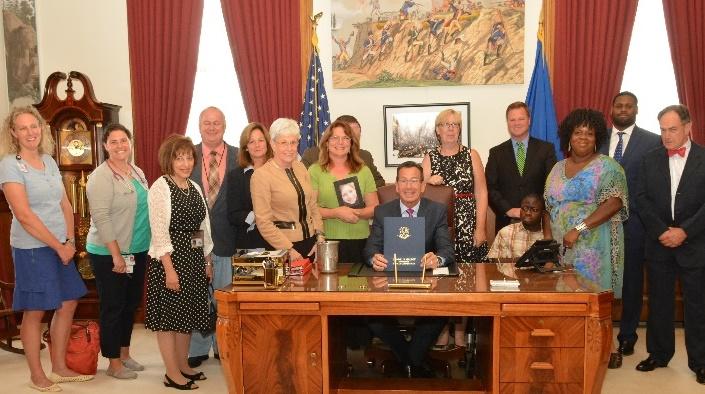
Lisa Saunders is seen below holding a photograph of her daughter Elizabeth (1989-2006) with Connecticut Governor Dannel P. Malloy at the ceremonial signing for “Public Act 15-10: An Act Concerning Cytomegalovirus” at the Office of the Governor in Hartford, CT, on July 28, 2015.


Lisa Saunders, a CMV parent and advocate, was instrumental in helping Connecticut become the second state to enact a law requiring the testing of newborns for CMV if they fail their hearing screen (2015). In 2022, New York passed "Elizabeth's Law" named in memory of her daughter, to require the provision of CMV educational materials to child care providers and pregnant women. Lisa is on the Advisory Board as Parent Advocate for PROACTIVE NYS, a long-term follow-up study of young children with congenital CMV, and is a member of New York DeafBlind Collaborative Expert Advisory Council. Lisa is the author of  "Had I Known about CMV: From Shock to Law." In 2023, she received the National CMV Foundation Spirit of Advocacy Award.


In 2023, National CMV Foundation honored Lisa Saunders with the Spirit of Advocacy Award. "Lisa has been working on CMV awareness since her daughter was born affected by the virus in 1989. Lisa’s work, in memory of her daughter, has resulted in CMV legislation in 2 states!" (CMV Conference ,Salt Lake City, Utah, Oct. 10, 2023). Amanda Devereaux RN, BSN, Program Director, National CMV Foundation, said, "Lisa's daughter was born severely disabled by congenital CMV in 1989 and she was unaware of CMV even though she was a licensed in-home childcare provider. Lisa's daughter died during a seizure at age of 16, so for over 30 years Lisa and her family have been staunch CMV advocates working to pass CMV legislation in both Connecticut and New York. She was recently featured in the USA Today article featuring her work on CMV awareness and screening. We're so grateful to Lisa for her years of work, inspiring countless other CMV families, including myself, and never taking no for an answer. She is just supremely dedicated to this cause, she just does not stop. So we are so proud of her." 


Lisa was the mother of Elizabeth born severely disabled by congenital cytomegalovirus (CMV) in 1989. Just prior to her pregnancy with Elizabeth, Lisa had a miscarriage but was not tested for CMV or other prenatal infections. Until Elizabeth's birth, Lisa was unaware of CMV and although she was a licensed, in-home child care provider, a church nursery volunteer and the mother of a toddler--all activities that put her at high risk for CMV--she was not educated about the disease and how to reduce her chances of contracting it. A graduate of Cornell University, Lisa is a public speaker, an award-winning writer and the author of several books--some with a CMV prevention message.

Updated 9/6/22. To download CMV resume (more like a CV), click here


LETTER FROM LISA SAUNDERS


“Wash Away CMV: Protect Your Pregnancy”


I am Lisa Saunders, the mother of Elizabeth, born severely disabled by congenital cytomegalovirus (CMV). My mission is to prevent Elizabeth’s suffering from happening to other children. According to the New York Times in 2016, CMV Is a Greater Threat to Infants Than Zika, but Far Less Often Discussed.

Most pregnant women know to avoid dirty kitty litter and mosquito bites to protect their unborn babies from disabilities caused by infections.  Very few, however, know how to prevent the leading viral cause of birth defects, congenital CMV. Congenital (present at birth) CMV is a more common cause of disabilities than fetal alcohol syndrome and spina bifida. Of the four million infants born each year in the U.S., approximately 1% are infected prenatally with CMV according to the American Academy of Pediatrics (AAP).  Ten percent of those infants, about 4,000 babies each year, are born with one or multiple abnormalities including hearing and vision loss; intellectual challenges; cerebral palsy; and seizures.

CMV is often found in the bodily fluids of otherwise healthy toddlers. Toddlers can spread the disease to other toddlers by mouthing each other’s toys, and to their adult caregivers who may be unaware of how to properly handle bodily fluids such as saliva and nasal secretions. Unfortunately, most women of childbearing age don’t know about CMV, and don’t realize they should avoid kissing toddlers around the mouth, as well as sharing cups and utensils with them. I was one of those women.

While I was pregnant with Elizabeth, I operated a licensed home daycare center, volunteered in our church nursery, and was the mother of a toddler—all things that put me at higher risk for contracting CMV.

My pregnancy with Elizabeth, due to be born on Christmas Eve of 1989, was a happy experience—until the moment she arrived on December 18th. Upon looking at her, I felt a stab of fear. My immediate thought was, “Her head looks so small—so deformed.” After a CAT scan, the neonatologist said, "Your daughter has microcephaly—her brain is very small with calcium deposits throughout. If she lives, she will never roll over, sit up, or feed herself." Further tests revealed Elizabeth's birth defects were caused by congenital CMV.


I was then given information from the Centers for Disease Control and Prevention (CDC) stating that, "People who care for or work closely with young children may be at greater risk of CMV infection than other people because CMV infection is common among young children..." This information came too late to spare my daughter the years of suffering that lay ahead. Nowhere in my daycare licensing training was CMV mentioned. CMV prevention was not discussed in my prenatal doctor visits. 

I felt sick at what my lack of knowledge had done to my little girl. In milder cases, children with congenital CMV may lose hearing or struggle with learning disabilities. But Elizabeth's case was not a mild one. When my husband Jim heard Elizabeth's grim prognosis, he stared at her and said, “She needs me”—just like Charlie Brown with that pathetic Christmas tree.

It took me about a year, but I eventually stopped praying that a nuclear bomb would drop on my house so I could escape my overwhelming anguish over Elizabeth's condition. Life did become good again—but it took a lot of help from family, friends, some Valium, and the Book of Psalms. Although Elizabeth was profoundly mentally impaired, legally blind, had cerebral palsy, epilepsy and a progressive hearing loss, we were eventually able to move forward as a happy, "normal" family. 

Years later, I awoke feeling so proud of Elizabeth. It was her 16th birthday and just one week before her 17th Christmas. When the song “I’ll be home for Christmas” played on the radio, I cried thinking how hard Elizabeth fought to be home with us, overcoming several battles with pneumonia, major surgeries, and seizures. Weighing only 50 pounds, she looked funny to strangers because of her small head and adult teeth, but she was lovely to us with her long brown hair, large blue eyes and a soul-capturing smile. She even won the "Best Smiling Award" at school. Although still in diapers and unable to speak or hold up her head, Elizabeth loved going for long car rides. She especially enjoyed school and being surrounded by people, paying no mind to the stares of “normal” children who thought she belonged on the "Island of Misfit Toys."

In 2006, less than two months after she turned 16, I dropped Elizabeth off at school. Strapping her into her wheelchair, I held her face in my hands, kissed her cheek, and said, “Now be a good girl today.” She smiled as she heard her teacher say what she said every time, “Elizabeth is always a good girl!” With that, I left.

At the end of the day, I got the call I always feared. “Mrs. Saunders, Elizabeth had a seizure and she’s not breathing." The medical team did all they could, but she was gone. While holding Elizabeth’s body on his lap, my husband looked down into her partially open, lifeless eyes and cried, “No one is ever going to look at me again the way she did.”


Shortly after Elizabeth died, I had a nightmare: visiting a support group of new parents of children with congenital CMV, they suddenly looked at me and asked, “Why didn’t you do more to warn us about CMV?”

Although I had written about Elizabeth’s life with her tomboy sister and a series of dysfunctional pets in my book, “Anything But a Dog: the perfect pet for a girl with congenital CMV,” which was also published in Japan, CMV remains largely unknown.

In 2012, because of my online presence as a writer and speaker about CMV, I received an email from a grandmother distraught about her grandson born with congenital CMV. The baby’s mother was a high school student interning in a Connecticut childcare center. The young mother, just like me many years earlier, was unaware she was putting her pregnancy at greater risk by working with toddlers. Eight - 20% of caregivers/teachers contract CMV
(AAP et al., 2011). About 44 to 100% of two-year-olds in group daycare are excreting CMV (Pass et al., 1986).

When I visited the new mother and baby in the hospital, the attending nurse asked me, "Knowing what you do about CMV, why don’t you launch an awareness campaign?"

I explained to the nurse that CMV parents, scientists and doctors have been trying for years to raise awareness but we can’t sustain meaningful, long-term change without government help. “Despite being the leading cause of mental retardation and disability in children, there are currently no national public awareness campaigns on CMV” (Clinical Advisor, 2014).

I finally made some headway in 2015. By modeling efforts in Utah, I helped Connecticut become the second state to pass a law requiring babies who fail their hearing exam to be tested for CMV. But CMV prevention education is also needed—especially since studies have shown that the effectiveness of hygienic precautions is greater than 75% (Adler, 2015).

According to a recent study, only 18.5% of licensed “in-home” daycare providers have heard of CMV and “Providers do not know how to appropriately sanitize surfaces to reduce spread of disease” (Thackeray et al., 2016).  For example, many providers use diaper wipes to clean a surface, but diaper wipes do not sanitize it.  Given that “61 % of children under the age of 5 are cared for in a child care facility...Intervening with child care providers and parents through child care facilities are key opportunities to reduce prevalence of CMV infection and other diseases.” 

My goal is to make CMV prevention required training in child care centers across the country. The American Academy of Pediatrics states in their book, “Caring For Our Children,” that “Child care staff members should receive counseling in regard to the risks of acquiring CMV from their primary health care provider. However, it is also important for the child care center director to inform infant caregivers/teachers of the increased risk of exposure to CMV during pregnancy.”

“Increasing risk perception is important because providers may not be concerned about taking measures to reduce the probability of infection if they feel that they are at low risk” (Thackeray et al., 2016).

According to the Occupational Safety and Health Administration (OSHA), it is a worker's right to know occupational hazards. Given there are more than half a million child care workers in the U.S. (Childcare Aware of America, 2016), that mothers of children in daycare are also at increased risk for CMV  (Pass et al., 1986), and that congenital CMV costs the U.S. health care system approximately 1.86 billion annually (Modlin, et al., 2004), it’s time for a national CMV prevention campaign.


To help prevent CMV (and other diseases spread by saliva), I provide educational materials for the whole family with my “color-me-in” fairytale, “Once Upon a Placemat: A Table Setting Tale,” which includes a free teaching toolkit. The fairytale, co-authored by my daughter Jackie Tortora, uses "Grandma" to speak for “Miss Cup” to enforce germ prevention, and features “Mr. Knife's” fear of the dish running away with the spoon to teach table-setting. The teaching toolkit includes  placemats, with the tableware characters correctly arranged, for downloading, coloring and laminating. The other side of the placemat features germ prevention and hand-washing tips. A YouTube video introduces children to the placemat characters and how to download the free placemats.

I present CMV prevention education through workshops,  public service announcements, health fairs, and my articles such as  "The Danger of Spreading CMV: How We Can Protect Our Children" (ChildCare Aware of America, 2017). I interview health experts, including Yale University doctors, on “The Lisa Saunders Show” (SEC-TV, channel 12 and YouTube) and regularly write about CMV in newsletters to healthcare professionals, for my “Congenital CMV”  blog, and for germ-fighting organizations such as “Henry the Hand.” My Facebook pages,  "CMV in Child Careand "Congenital CMV News," encourage behavioral changes through hand-washing and no cup sharing campaigns.


If you can help raise CMV awareness, according to studies on prevention, our nation should have a higher number of healthy newborns.

Thank you in advance for your help! 


###


Lisa Saunders is seen below holding a photograph of her daughter Elizabeth (1989-2006) with Connecticut Governor Dannel P. Malloy at the ceremonial signing for “Public Act 15-10: An Act Concerning Cytomegalovirus” at the Office of the Governor in Hartford, CT, on July 28, 2015.


CMV ceremonial signing Malloy

Connecticut Governor Dannel P. Malloy at the ceremonial signing for “Public Act 15-10: An Act Concerning Cytomegalovirus” at the Office of the Governor in Hartford, CT, on July 28, 2015.  (L to R): Jane Baird, Government Relations, Connecticut Children's Medical Center; Dr. Wallis Molchen, Chief Resident, Connecticut Children’s Medical Center; Jane Brancifort, Deputy Commissioner, Connecticut Department of Public Health; State Representative, John Hampton; Dr. Brenda K. Balch, American Academy of Pediatrics Early Hearing Detection and Intervention Chapter Champion; Lt. Governor Nancy Wyman; Lisa Saunders, parent rep, Congenital Cytomegalovirus Foundation, holding picture of daughter Elizabeth; Kevin Ryan, State Representative; Governor Dannel P. Malloy; Cathy Osten, State Senator; Ken Hiscoe, Pfizer, Government Relations; Jarred and his mother, Melvette Ruffin; DeVaughn Ward, Liaison, Department of Public Health; and Kinson Perry, lobbyist at Rome, Smith & Lutz.


 Contact Lisa Saunders
 LisaSaunders42@gmail.com

Types of Organizations Lisa collaborates with: click here


* The "Spirit of Advocacy Award is given to an individual or family who has been impacted by congenital CMV. The recipient has/have demonstrated dedication to CMV advocacy efforts nationally or locally within their state/region. Recipients have used their personal struggle with CMV to advocate for CMV education, awareness, and/or policy change in an effort to prevent pregnancy loss, childhood death, and disability due to CMV. " 


Monday, November 7, 2016

What can you do to stop CMV, the #1 birth defects virus?

Ever since that recent New York Times article, "CMV Is a Greater Threat to Infants Than Zika, but Far Less Often Discussed," people across the country are finally understanding the threat of the #1 birth defects virus, CMV. 


According to Clinical Advisor, "Despite being the leading cause of mental retardation and disability in children, there are currently no national public awareness campaigns to educate expecting mothers about congenital CMV."

Until our government and medical community invests time in preventing CMV through raising awareness as they have Zika, there are ways you can help protect the unborn from this aweful suffering, plus save millions dollars in medical costs. Depending on your interests, time and skill sets, you may be suited for raising awareness, funds, or promoting research. Limited in time? Just handing your primary care physician or local day care center a CMV prevention flyer to hang on their wall and/or bathroom stall can save lives and anguish (see image below for a simple flyer created by the National CMV Foundation).


If you are really ready to role up your sleeves, then ask your state to pass a CMV bill such as the one in Utah. I, along the CMV families and medical professionals, helped get one passed in Connecticut, mentioned in the New York Times article, "CMV Is a Greater Threat to Infants Than Zika

There are several organizations you can join forces with to help prevent this tragedy until an effective vaccine is invented (see below my bio for a list with live links to them). Many have helpful flyers and news for sharing. 

At present, this is what I'm working on in case you are interested in collaborating on anything: 


Facebook: Congenital CMV News:https://www.facebook.com/congenitalcmvnews/ 

Day Care Centers: I'm trying to get the Occupational Safety and Health Administration (OSHA) to raise a CMV prevention/awareness campaign for day care workers, the way they do for outdoor workers in regard to Zika. I am also in touch with Connecticut's local union for child care providers, CSEA/SEIU Local 2001. I am still trying to figure out how to get the CT Office of Early Childhood webpage to include CMV prevention and to include it in their training for licensed day care providers (my CMV information was forwarded to their Division Director, Debra Johnson). (I also emailed
Jennifer Johnson, Director of Quality Improvement at Connecticut Office of Early Childhood,
jenn.m.johnson@ct.gov). Here is Utah's day care provider brochure:  http://health.utah.gov/cshcn/pdf/CMV/CMV%20What%20Childcare%20Providers%20Need%20to%20know.pdf. As a result of Utah's request to provide CMV prevention for their childcare workers, The Church of Jesus Christ of Latter-day Saints produced the following funny video, "Interview with a Germ: Communicable Disease Safety," which stars Rhonda Rhinovirus, a germ who loves to tell travel adventure stories, including those by CMV (which is a herpesvirus, like chicken pox). Watch: https://www.lds.org/callings/church-safety-and-health/training-and-video-resources/communicable-diseases?lang=eng. Here is my message to day care organizations: Former Childcare Provider Lists 13 Things You Should Know/Do About CMV--Much More Widespread Than Zika

Free Teaching Toolkit: I created free, downloadable placemats with germ prevention for coloring prevention with free, downloadable “color-me-in" placemats that includes a germ prevention tip from Miss Cup who insists no one share her.  Find the placemat at: https://drive.google.com/file/d/0B9Klfxar2CmjbWlfQlpGS3VDMlBXVklDN0JnM0lxa3lXRVpR/view   (I left space at the top for organizations to include their logo/info if so desired before printing copies). The placemat characters are from my booklet, "Once Upon a Placemat: A Table Setting Tale." Click on this short video to learn more about them. 

Public Speaking. My next talk is: 
January 26, 2017, 11:30am--Talk: "Congenital CMV and Research" at the 37th Annual Meeting of the Society of Maternal Fetal Medicine (1/23-28/2017). Caesars Palace, Las Vegas, NV. Research support staff deal with diseases in pregnancy to help find answers for prevention and treatment. This discussion will entail the story of a mother, Lisa Saunders, whose child was affected by CMV and her quest to raise awareness about maternal testing for first infection during pregnancy, newborn testing and the need to develop a vaccine. She needs evidence – based medicine to support her quest. The second part, presented by Brandy Sandra Firman, BSPH, BSDMS, of Drexel University, will cover the factors that affect pregnant women who volunteer to help researchers produce the evidence needed for disease prevention and treatment. This forum is meant to explore the reasons for participating in a research trial and the need for participation in a research trial from a patient’s perspective. Info:https://www.smfm.org/meetings/2-37th-annual-pregnancy-meeting or contact: Sabine Bousleiman M.S.N,M.S.PH, Program Director, Columbia University, OBGYN Department, (212) 305 4348 (office),  (917) 673 7790(mobile), sb1080@cumc.columbia.edu. Learn more about "A Randomized Trial to Prevent Congenital Cytomegalovirus (CMV)" at: https://www.clinicaltrials.gov/ct2/show/NCT01376778

Video: I made a short video of CMV prevention with images of my daughter's life and death with the disease. Watch: https://mail.google.com/mail/u/0/#inbox/1583f9b5fcbdabd5?projector=1

Book about child with congenital CMV--U.S. and Japan: I am working with Japanese medical professionals and publisher to get my CMV memoir, “Anything But a Dog! The perfect pet for a girl with congenital CMV (cytomegalovirus),”   translated into Japanese to be released in Japan in December 2016. A book about my daughter's life,  “Anything But a Dog! The perfect pet for a girl with congenital CMV (cytomegalovirus),” was shown in the background of the live video interview with Dr. Demmler-Harrison embedded in the New York Times article, "CMV Is a Greater Threat to Infants Than Zika

Murder Mystery Writers: I'm contacting murder mystery writers in case I can interest them in--CMV and Agatha Christie's "The Mirror Crack'd from Side to Side"

Nurses: I'm contactinng nursing unions and organizations--Please Help Fight CMV--"Greater Threat to Infants" according to NY Times

About Me: 
Lisa Saunders is the parent representative of the Congenital Cytomegalovirus Foundation, which raises awareness about maternal testing for first infection during pregnancy, newborn testing, and the need to develop a vaccine. Saunders and her work to get Connecticut to pass a CMV bill was featured in Cornell’s Alumni Magazine (Sept/Oct 2015) and was widely covered in the media with interviews on Fox CT and News 8 at CT Capitol RE: CMV. She is the author of the memoir, Anything But a Dog! The perfect pet for a girl with CMV (cytomegalovirus), which is also being released in Japan in December 2016. A short story about her daughter Elizabeth's life with congenital CMV is told through images and music on this three-minute video. To educate entire families in a fun and memorable way, Saunders recently published the short booklet,  “Once Upon a Placemat: A Table Setting Tale,” which includes CMV prevention tips such as refraining from sharing dishes plus a free teaching tool kit with downloadable placemats for coloring and a video. Visit Lisa at www.authorlisasaunders.com


ORGANIZATIONS THAT WORK TO STOP CMV:

CMV Registry, CMV Research and CMV Clinic Congenital CMV Foundation
Gail J Demmler-Harrison, MD, Professor, Pediatrics, Section Infectious Diseases, Baylor College of Medicine, Attending Physician, Infectious Diseases Service, Texas Children's Hospital, CMV Registry, CMV Research and CMV Clinic. The CMV Registry supports CMV research, disseminates information and provides parent support. Visit: https://www.bcm.edu/departments/pediatrics/sections-divisions-centers/cmvregistry
Contact: 832-824-4330, gjdemmle@texaschildrens.org

National CMV Foundation 
“At the National CMV Foundation, we work to inform and educate others on specific prevention measures to protect against the risk of CMV infection.” They have a very good congenital cytomegalovirus Q. and A. at: https://www.nationalcmv.org/resources/faqs.aspx  They have simple flyers for downloading at: https://www.nationalcmv.org/resources/educational-downloads.aspxFlyer for the wall created by National CMV Foundation:


Congenital Cytomegalovirus Foundation 
Lenore Pereira, Ph.D., Founder of Congenital Cytomegalovirus Foundation, and Professor, Cell and Tissue Biology Department, University of California San Francisco.  The Congenital CMV Foundation raises awareness about maternal testing for first infection during pregnancy, newborn testing and the need to develop a vaccine. Excellent research papers available at: http://www.congenitalcmv.org/
Contact: lenore.pereira@ucsf.edu

National CMV Registry for Pregnant Women 
Stuart Adler, M.D., Professor Emeritus of Pediatrics and Professor of Microbiology and Immunology, Virginia Commonwealth University. He organized the National CMV Registry for Pregnant Women. Visit: http://www.cmvregistry.org/, contact: sadler@vcu.edu

Tuesday, November 1, 2016

Nurses: Please Help Fight CMV--"Greater Threat to Infants" according to NY Times

Nurses, women of childbearing age need your help. I am looking to you because you have always been concerned about preventing infectious diseases. 


Perhaps you can help raise awareness of the leading birth defect virus, congenital cytomegalovirus (CMV) now that the country is finally learning that CMV is much more widespread than Zika thanks to last Tuesday's New York Times article, "CMV Is a Greater Threat to Infants Than Zika, but Far Less Often Discussed."  The article includes mention of the CMV bill I helped get passed in Connecticut (to see what this law means to the medical community, see the Clinical Advisor article at: http://www.clinicaladvisor.com/web-exclusives/congenital-cytomegalovirus-cmv-connecticut-law/article/418100/)

The prevention education part of the Connecticut bill didn't pass, however, because it would have required funds, so I still rely on nurses and the media to get the message out there--especially now that American College of Obstetricians and Gynecologists (ACOG) has reversed it's decision to instruct their pregnant patients on prevention (you can read about that in the NY Times article). 

When I contacted the CDC in July 2016 to ask why they took down CMV prevention tips such as pregnant mothers refraining from kissing their toddlers around the mouth or sharing utensils with them, I received a response in August 2016 stating, "The prevention recommendations currently on the CDC website are consistent with 2015 guidelines from the American College of Obstetricians and Gynecologists (ACOG) and the American Academy of Pediatrics."  ACOG's position on CMV instruction, recently revised in 2015, is now that their patients will consider such guidelines difficult to implement because  "they often are considered impractical or burdensome." (see page 1514 of the ACOG Practice Bulletin (June 2015), [151 Cytomegalovirus, Parvovirus B19, Varicella Zoster, and Toxoplasmosis in Pregnancy (June 2015]) 

If ACOG won't promote CMV prevention education, can you help?

According to the Centers for Disease Control and Prevention (CDC), “About one out of every 150 babies are born with congenital [present at birth] CMV infection (http://www.cdc.gov/cmv/congenital-infection.htm) and "People who care for or work closely with young children may be at greater risk of CMV infection than other people because CMV infection is common among young children..." (http://www.cdc.gov/cmv/clinical/features.html). 

As a former licensed day care provider in Maryland, I was never warned that caring for young children put my pregnancy at risk and my daughter Elizabeth was born severely disabled by congenital CMV (she had the small head seen with Zika babies). Shortly after moving to Connecticut in 2010, I received a call from a local grandmother who said her grandson was just born disabled by congenital CMV. The baby's mother had been a college student interning at a Connecticut day care center while pregnant. She, too, had not been educated about CMV and how to protect her pregnancy. When I visited the mother and baby in the hospital, the attending nurse asked me why more wasn’t being done to raise awareness of this leading viral cause of birth defects. (I do what I can by writing and lecturing on the topic, including at a conference held at the Infection Control Nurses of Connecticut in April 2013, reference: Kris Magnussen, KMagnussen@llhd.org.)

I just compiled the list, "What are the 13 things childcare workers need to know or do about CMV?" and give links to the sources on my CMV blog at:  Former Childcare Provider Lists 13 Things You Should Know/Do About CMV--Much More Widespread Than Zika

I will be interviewing a pediatrician on my local access TV show next week about how we can all work together to raise a CMV prevention message. I would be happy to send you the link once it's uploaded to my YouTube channel if you write to me at LisaSaunders42@gmail.com

Thankfully, as a result of the CT CMV bill passing, the CT Department of Health has updated its website to include CMV prevention at:http://www.ct.gov/dph/cwp/view.asp?a=3138&q=527824. But, a lot more still needs to be done!

My daughter's life with congenital CMV is shown through images in the short, three-minute video below. My friend, Debra Lynn Alt, the former lead singer for the Rolling Stone magazine band, allowed me to set the slideshow to a song she wrote and performed for a boy with autism.

Thank you for your time.

Sincerely, 


Lisa Saunders, author/speaker
Parent Representative, Congenital Cytomegalovirus Foundation
845-222-8593 | LisaSaunders42@gmail.com | http://congenitalcmv.org/ | www.authorlisasaunders.com | PO Box 389, Mystic, CT 06355 | Lisa is author of ANYTHING BUT A DOG! The perfect pet for a girl with congenital CMV (cytomegalovirus).