Sunday, April 24, 2016

Sharing Drinks Can Cause Birth Defects


(Miss Cup illustrated by Marianne Greiner; courtesy of Lisa Saunders, author of Once Upon a Placemat)
Pregnant Moms: Sharing Drinks With Toddlers Can Lead to Birth Defects in Unborn Babies

Did you know toddlers can be shedding cytomegalovirus (CMV), the leading viral cause of birth defects? Congenital (meaning present at birth) causes mental retardation, liver disease, cerebral palsy and deafness—more disabilities than Down syndrome—as a result of infection in pregnant women‎. Data from a variety of day care center studies indicate that between 44 to 100% of two year olds at a single given time were shedding CMV. 

When I was pregnant, I was never warned about congenital (meaning present at birth) CMV and how to prevent it until it was too late for my daughter, Elizabeth, born severely disabled by congenital CMV. If you have never heard of congenital CMV, you are not alone. Only 7% of  men and 13%  of women surveyed had heard of congenital CMV.


I am Lisa Saunders, the parent representative of the Congenital Cytomegalovirus Foundation (http://www.congenitalcmv.org) and  I will continue to write and speak about congenital CMV until it is a standard practice of care to educate women of childbearing age how to prevent it, or, until an effective vaccine is made available..


How prevalent is congenital CMV?


·           Every hour, congenital CMV (or cCMV) causes one child to become disabled.

·           Approximately 1 in 150 children is born with cCMV infection (30,000 each year).

·           About 1 in 750 children is born with or develops permanent problems due to congenital CMV infection. More than 5,000 children each year suffer permanent problems caused by cCMV.

How can you protect your unborn baby from congenital CMV?

The risk of getting CMV through casual contact is small--it is generally passed to others through direct contact with body fluids, such as urine and saliva. CMV is often being shed by apparently healthy toddlers. Therefore:

·         Avoid putting your child’s food, utensils, drinking cups, and pacifiers in your mouth.

·         Kiss your children on the forehead or cheek instead of the lips.

·         Wash your hands after changing diapers, wiping runny noses, picking up toys. (More: cdc.gov/features/prenatalinfections)

Will it make a difference if women are educated on CMV prevention?

Yes, according to studies in the U.S. and France. Dr. Demmler-Harrison, Director, Congenital CMV Disease Research, Clinic & Registry, states: “Studies have shown that women who know they are CMV seronegative, know they are pregnant, and know about their toddler's CMV shedding are the most likely to prevent CMV transmission and reduce their risk from over 50 percent during pregnancy to a risk of less than 5 percent during pregnancy.  It is not likely that isolated instances of exposure to saliva or drool will result in transmission. Most studies suggest prolonged repeated exposures over time are important for CMV transmission.”

If more people knew about human CMV (HCMV), not only would children be spared the suffering my daughter endured for 16 years until her death during a seizure in 2006, but one reason for the delay in successful development of a vaccine is “there has been insufficient education about the problem of HCMV infection…”   

Why don’t doctors routinely warn women of childbearing age about congenital CMV?

Doctors don’t realize how prevalent it is. Fewer than half (44%) of OB/GYNs surveyed reported counseling their patients about preventing CMV infection. “The virtual absence of a prevention message has been due, in part, to the low profile of congenital CMV. Infection is usually asymptomatic in both mother and infant, and when symptoms do occur, they are non-specific, so most CMV infections go undiagnosed,” according to the article, “Washing our hands of the congenital cytomegalovirus disease epidemic.”

What you can do to stop congenital CMV

1.    Visit the CDC’s website about congenital CMV at http://www.cdc.gov/cmv/index.html and share it with others.

2.    Share this article with your friends, family and on your social media. Children will enjoy coloring the free downloadable placemats linked below, which include germ prevention tips on the back.

What I am doing to try to stop congenital CMV

I was recently instrumental in getting a law passed in Connecticut requiring testing infants for congenital CMV if they fail the required hearing screen. If a baby tests positive for congenital CMV, doctors can choose to offer the antiviral shown to improve outcomes (brain size, hearing, etc.).  The prevention education part of the Connecticut bill did not pass because it was estimated to cost the state $40,000 a year to educate the public about CMV. (See endnote for what it costs the U.S. not to educate the public about congenital CMV, and using Connecticut as an example, how you can calculate the cost to your state).

Until health care professionals take over the work of educating the public about CMV prevention, I will continue to speak to groups and write books and articles about this #1 birth defects virus. I am the author of the memoir, Anything But a Dog! The perfect pet for a girl with CMV (cytomegalovirus), and recently published the short, lighthearted family fairytale, “Once Upon a Placemat: A Table Setting Tale,” which comes with a free downloadable program kit:

1.    A short video introducing the tableware characters and why they want a bath before being shared: https://youtu.be/_0jDOKPFg4M


2.    Placemats with the tableware characters and germ prevention tips: https://drive.google.com/file/d/0B9Klfxar2CmjZUNDdHFwQkVmbWs/view?usp=sharing (there are versions of the placemat that provide organizations open space to insert their own logo/information before distributing).


Please share this information to help prevent the suffering caused by congenital CMV.

Sincerely,


Lisa Saunders
PO Box 389, Mystic, Connecticut, 06355
http://authorlisasaunders.blogspot.com/
https://www.youtube.com/user/anythingbutadog
https://twitter.com/saundersbooks
https://www.linkedin.com/in/lisasaundersbooks

Lisa Saunders is an award-winning writer and TV talk show host. A graduate of Cornell University, she is the author of seven books, is a part-time historical interpreter at Mystic Seaport and instructor at New London Adult and Continuing Education. She lives in Mystic, Connecticut, with her husband, Jim, and hound, Doolittle, where she created a little history of her own by helping Connecticut become the second state in the country to enact a law combating the #1 viral cause of birth defects, congenital cytomegalovirus (CMV), a disease that led to the disabilities and death of her younger daughter, Elizabeth. Contact Lisa directly for author visits at LisaSaunders42@gmail.com.
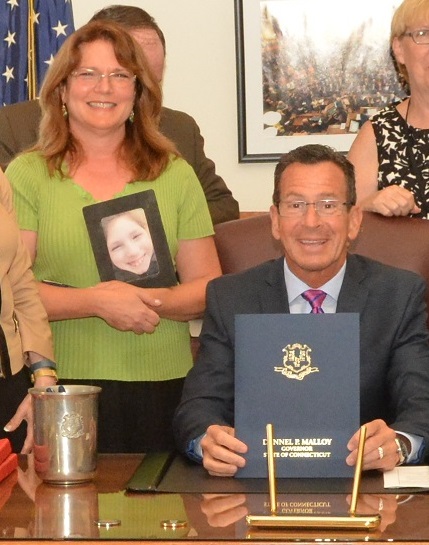
Lisa Saunders is pictured with Connecticut Governor Dan Malloy holding a photograph of her daughter Elizabeth (1989-2006), born disabled by congenital CMV, at the ceremonial bill signing for “Public Act 15-10: An Act Concerning Cytomegalovirus” at the Office of the Governor in Hartford on July 28, 2015.
 

Endnote:

What is the annual cost of caring for children disabled by congenital human cytomegalovirus (HCMV) in the U.S. and by state?

“In the early 1990s, the expense to the US health care system associated with congenital HCMV  infection was estimated at approximately $1.9 billion annually, with a average cost per child of over $300,000” (Arvin et al. 2004). In 2013, 3,932,181 babies were born in U.S. with 1/750, or .0013, disabled by cCMV = 5,112 babies.   

Connecticut’s annual cost of caring for children disabled by cCMV can therefore be calculated as:  36,085 births X .0013 cCMV disabled = 47 babies X $300,000/year = $14,100,000 or over $14 million annually.
 

Friday, March 4, 2016

Surviving Loss: The Woodcutter's Tale


Surviving Loss: The Woodcutter's Tale

Once upon a time, long, long ago in a faraway land, lived Hans, a woodcutter, and his wife Hilda. They had a 19-year-old daughter Matilda and a ten-year-old son Stefan.

It came to pass that the countryside was ravaged by sickness accompanied by high fever that caused many to perish. Stefan was stricken and shortly became very ill.

The woodcutter summoned the old midwife, a gray-haired woman who also served as a doctor. “Hans, Hilda, I am sorry to tell you that Stefan is beyond my help and must soon die.”

Struck speechless by this pronouncement, they heard the neighing and hoof beats of horses outside their cottage. Hans went out to discover that the Princess in her royal coach had stopped.

“I was returning to my castle when I heard your son was sick. Bring me to him.” Hans led the Princess inside and she beheld the dying Stefan.

“Let me take him home with me and I will heal him. However, I will keep him with me as I have no sons after four years of marriage.” Although it broke their hearts, Hans and Hilda agreed for they knew it was best for Stefan.

The Princess herself picked Stefan up to carry him to the carriage. As soon as the Princess lifted him, Stefan started to look better. The Princess placed him in the coach seat opposite her and the coach drove off, leaving the couple waving goodbye with tear-stained faces.

Life was not the same in the little cottage, although the family seemed closer together then ever before. Their shared grief was an invisible weight pressing upon their shoulders, made bearable only by the sharing.

Three days after Stefan’s departure, a white dove appeared and made a nest in their thatched roof. Strangely, the family felt comforted by the presence of the dove that never left their roof. Hans always looked for it when he returned from his wood-cutting forays into the forest. Hilda and Matilda often looked up when they were doing their outdoor chores to see if the dove was still there, and to experience the sense of consolation and protection, which seemed to emanate from the dove.

After a few years, Matilda married a cooper and moved to a village about ten miles distant. Though they missed their daughter greatly, the couple now had the dove for company.

Finally, stricken with years, the old couple became weaker and weaker and sensed that they both were going to die. Hans said, “Let us go outside, bring our bench and sit on it, hold hands and look at our dove.” Hilda agreed and they brought their bench outside. They settled themselves on the bench and faced their cottage, but were surprised to see that the dove was no longer on the roof.

Finally growing too feeble to move, they heard the sound of horses’ hooves. With their last breaths, they beheld the royal coach approaching. As the coach drew near, they saw a smiling Stefan inside, dressed in shining white garments and looking every inch a Prince. “Come home with me,” said Stefan. Overjoyed, and amazed that they suddenly no longer felt feeble, the couple stepped into the coach.


As the coach started to pull away, Hans and Hilda looked back to see if their dove had returned. But the dove, no longer needed, was gone. This disappointment was replaced by their boundless joy at seeing how happy Stefan had been and by knowing they would be with Stefan forever in their new home.


THE END

If you would like to see more illustrations for this story, download the free pdf by clicking here.

If you would like to purchase a softcover version of the above fairy tale, which includes the following comments from a licensed mental health professional about loss and grieving, it is available on Amazon by clicking here.


AFTERWORD
by

 Julie Russell, Licensed Clinical Social Worker


The Woodcutter’s Tale demonstrates the stages of grief while highlighting the continued love the couple has for their child. It is important to understand the stages of grief to gain insight into when one may need additional help by a professional. A traumatic event, often a death of a loved one, causes those who are connected to the loss to experience the multiple stage process known as grief.


Understanding grief also empowers those who continue to love the individual who has passed. Five stages of grief are cited frequently as introduced by Dr. Elizabeth Kubler-Ross in 1969. Grief is unique to each individual and is characterized by the relationship between the survivor and the loss.


DENIAL. Not believing the death is real is recognized as the first stage. Often a person is emotionally shocked and may question whether the person has died. This first stage allows emotions to be placed on hold and critical decisions regarding burial, organ donation and other arrangements to be made.


ANGER. The overwhelming feeling of anger is often the second emotion experienced. This is at times directed toward the person who died, healthcare professionals, and oneself. During this stage one may wonder why God would allow death and suffering to occur. When the care-giving process involves difficult decisions survivors often feel increased burden. One may express the pain of anger as irritation or frustration. Anger is never a bad emotion, but a necessary one for many to reach a sense of peace.


BARGAINING.As individuals work through the anger and pain, an intellectual aspect enters the grieving process. It is during this time that a person wonders “What if I had…” or “If only the medical treatment had …” Intellectual answers are inserted in the areas where those left must fill emotions questions. Often denial, anger and bargaining occur to some degree at once. A Survivor will momentarily forget the death has occurred, usually in the process of performing a formally routine task such as picking up the phone to call the individual or entering the room a loved one was cared for when ill. Upon remembering one may face anger or begin the process of questioning what may have been a series of difficult decisions.


SADNESS. The loss of a loved one leaves a hole in the survivor’s life. The emptiness can often be described as sadness and loneliness. This, like anger, is a normal response to the death of a loved one. This hole may threaten to consume someone after a loss, but it is common to all who have experienced grief.


ACCEPTANCE. The final stage of grief is acceptance. Life will never be the same, and accepting the death of a loved one does not equate to agreeing with it, or not wishing it had occurred. It only means that the survivors understand that the death has occurred and it is permanent. Acceptance most often comes in bits and pieces as one cycles through the stages of grief. A person has less intense periods of denial, pain, bargaining and sadness as the moments of acceptance become longer.


Grief is both a healthy and a normal response to loss – it is the process that leads to peace. In this tale, a couple adjusted to their loss of a child by finding a direction for their continued love--the dove.


While grief is a normal response to loss, individuals often find navigating its complexities with a licensed therapist beneficial. Many health insurance companies cover services related to grief and loss and there are support groups in most communities. Lisa Saunders shares how she navigates her grief and continues to live a complete life following the death of her daughter in the following account. Grief is a path that many navigate which allows them to continue to find meaning and purpose in life.


Julie Russell, MSW, LCSW, is a clinical social worker specializing in the treatment of trauma and the scope of emotional and mental disorders that prevent one from achieving a sense of wholeness.


Saturday, February 27, 2016

My baby was born with microcephaly: CMV versus Zika

 
My name is Lisa Saunders and I live in Mystic, Connecticut.

 
My daughter, Elizabeth Saunders, was born with microcephaly (see attached), and although Zika is in the news, cytomegalovirus (CMV), the #1 birth defects virus, is barely mentioned--and it's preventable if women know about it!
 
Arizona's 12 News just did a piece on how much more widespread CMV is (and how to prevent it): http://www.12news.com/news/virus-that-causes-worse-birth-defects-than-zika-is-already-in-us/53562672

 
According to the CDC, congenital (meaning present at birth) CMV causes one child every hour to become disabled in the U.S. That is over 5,000 a year. See: http://www.cdc.gov/cmv/index.html

 
I'm the parent representative of the Congenital Cytomegalovirus Foundation and was instrumental in getting Connecticut to become one of the few states in the U.S. to pass a law to help mitigate congenital CMV (the law went into effect this year). 

Unfortunately, the prevention education part of the CT CMV bill didn't pass because of funds. That is why I'm turning to the media to help educate the public as it has for Zika as a cause of microcephaly (having a small, damaged brain can mean mental and physical disabilities, epilepsy, etc.). To help you find an angle to cover it, I created the following press release about the disease and my work to help prevent it through my new table-setting fairytale with an appendix for adults on why they shouldn't share cups, etc., with children (I did a short video to introduce the book to children at: https://youtu.be/_0jDOKPFg4M). CMV is spread by bodily fluids and most women contract it from their apparently healthy toddlers because they share cups/utensils with them (along with kisses on/near the mouth).  If the woman is pregnant, she can pass the virus onto her developing baby.

 
Studies done in the U.S. and France show that if women are educated on how to prevent CMV, they will greatly reduce their chances of contracting it. Only 7% of  men and 13%  of women surveyed had heard of congenital CMV.


Media coverage on my new children's book include:

 
Please see the following press release and photographs for more information.


Sincerely,

 
Lisa Saunders
P.O. Box 389
Mystic, CT 06355

 
IMMEDIATE RELEASE


Mother Writes Table-Setting Fairytale to Stop #1 Birth Defects Virus

(and to explain how the knife stops the dish from running away with the spoon)

 
 “Once Upon a Placemat: A Table Setting Tale” includes germ prevention


Mystic, Conn.—  Lisa Saunders wrote Once Upon a Placemat: A Table Setting Tale to teach children how to set the table in a fun and memorable way, in addition to teaching their parents how to stop the leading viral cause of birth defects, congenital cytomegalovirus (CMV), which is spread when cups and other dishware are shared. The "Placemat" characters are available for coloring on free downloadable placemats, which also includes germ prevention tips, at: https://drive.google.com/file/d/0B9Klfxar2CmjbHROT0Y5RG1RQ3M/view?usp=sharing (This link includes a version of the placemat available to organizations who would like to distribute it with their own information/logo placed in the top open space.)

 
Lisa Saunders is an award-winning writer living in Mystic, Connecticut, with her husband and hound. A graduate of Cornell University, she is the parent representative of the Congenital Cytomegalovirus (CMV) Foundation, and in 2015, was instrumental in helping Connecticut become one of the few states in the country to enact a law combating the leading viral cause of birth defects, congenital (meaning present at birth) CMV.  Saunders said, “CMV is carried by a high percentage of apparently healthy toddlers. It is found in bodily fluids such as saliva and is of concern to women of childbearing age because the virus can lead to complications in their baby's development if they are pregnant while infected.”

 
Saunders’ daughter, Jackie Tortora, co-authored “Once Upon a Placemat: A Table Setting Tale,” which includes recipes of the foods eaten in the story. Tortora is a digital strategist living with her husband and their young son in Vienna, Virginia. 

 
“Once Upon a Placemat” is an expanded version of the fairytale Saunders told in her children’s novel, “Ride a Horse Not an Elevator,” which is featured in the Cornell University 4-H “Horse Book in a Bucket Program.”

 
“Once Upon a Placemat” is illustrated by Marianne Greiner of Bloomfield, New York.  

 
For more information, visit www.authorlisasaunders.com or write to LisaSaunders42@gmail.com


###


Photograph captions:
Mother Lisa Saunders holds her new baby, Elizabeth, born in 1989 with microcephaly from congenital cytomegalovirus (CMV). Her older daughter looks on. Elizabeth struggled with physical and mental disabilities for 16 years, in addition to a hearing loss, until her death during a seizure in 2006. Photograph by James P. Saunders.

 
Lisa Saunders holds a photograph of her daughter, Elizabeth (1989-2006), next to Governor Dannel P. Malloy at the ceremonial bill signing for Public Act 15-10: An Act Concerning Cytomegalovirus at the Office of the Governor in Hartford, Conn., on July 28, 2015.


List Price: $6.99

Publication Date: Feb 02 2016

ISBN/EAN13:1523750790 / 9781523750795

Page Count: 40

Trim Size: 6" x 9"

Language: English

Color: Black and White

Related Categories: Juvenile Fiction / Cooking & Food

Friday, February 5, 2016

Fairytale Teaches Table Setting and CMV Prevention

In honor of February being International Prenatal Infection Prevention Month, I have created a fun, free downloadable placemat for coloring that features the tableware characters from my new fairytale, Once Upon a Placemat: A Table Setting Tale. It includes infection prevention (not just prenatal infections, but others that are transmitted through saliva).
 

Many children don't know how to set the table so I thought the fairytale would be a useful tool for families. In addition to learning how to arrange the tableware, children will learn the importance of  washing hands before meals and refraining from sharing unwashed dishes.
 
Children (and sometimes adults) can be guilty of asking another to share a sip from their cup without realizing the possible serious health consequences. In addition, some mothers of childbearing age don't realize they shouldn't share dishes with their young children as a child's saliva could contain cytomegalovirus (CMV), a virus that is usually harmless to them, but can have devastating consequences if a woman catches CMV while pregnant. Congenital (present at birth) CMV is the leading viral cause of birth defects.
 
For more information about the fairytale, early reviews,  and the free placemat, see the following press release.

Thanks!
 
Lisa Saunders

PO Box 389, Mystic, CT 06355
www.authorlisasaunders.com

FOR IMMEDIATE RELEASE


Grandmother Lisa Saunders Teaches Table Setting Skills
To Keep the Dish from Running Away With the Spoon  


Fairytale told to a little girl in “Once Upon a Placemat” includes germ prevention (including those that cause prenatal infections)


Mystic, Conn.—  Lisa Saunders, a grandmother in Mystic, wrote a table-setting fairytale to teach children how to set the table in a fun and memorable way. Her daughter, Jackie Tortora, co-authored “Once Upon a Placemat: A Table Setting Tale,” which includes recipes of the foods eaten in the story, plus germ prevention tips. The "Placemat" characters are available free for downloading and coloring by clicking here *(reverse side of placemat lists disease spread through saliva plus the CDC's recommendations for hand washing).
 
About the book: When a young girl can't remember how to set the table, her grandmother teaches her to listen to the silverware. Learn why the table is set the way it is. Why does the knife keep a sharp eye on the plate? Why does the fork want a napkin bed and the cup insist she and the others get a bath before being shared?

"Once Upon a Placemat finally accomplished what we could not--getting our kids to remember how to correctly set the table! Now, I hear my 12-year-old saying to herself, “Mr. Knife stands between Mrs. Spoon and Mr. Plate. Mr. Knife keeps his eyes and teeth toward Mr. Plate because he doesn’t trust him since there was that time the ‘dish ran away with the spoon.’ What a brilliant extension to an old nursery rhyme.Once Upon a Placemat’ will also help your kids better understand the importance of washing their hands before meals and not sharing dishes. Short story--big impact. Finally, a story that sticks!” said Dr. Rebecca Cihocki, an audiologist in Scottsdale, Arizona.

 
"The lesson of how to set a table is valuable as this is part of encouraging a family to sit down and eat together—a main intervention in preventing obesity," said Alison Dvorak, MS, RDN, CDN, of Franklin, Connecticut.

Once Upon a Placemat  is a charming story of how the eating utensils came to arrange themselves on the table in the time honored elegance of a table well set. In addition to creating an atmosphere for families to eat healthy dinners together, Lisa Saunders provides parents and caregivers with valuable information about how to prevent the spread of cytomegalovirus (CMV), the leading viral cause of developmental disabilities in infants. The information is easy to understand and yet very thorough. Great references for more information,” said Dr. Joanne Z. Moore, owner of Shoreline Physical Therapy in East Lyme, Connecticut.

Once Upon a Placemat ” is an expanded version of the fairytale Saunders told in her children’s novel, “Ride a Horse, Not an Elevator,” which is featured in the Cornell University 4-H “Horse Book in a Bucket Program.”


Lisa Saunders is an award-winning writer living in Mystic, Connecticut, with her husband and hound. A graduate of Cornell University, she is the parent representative of the Congenital Cytomegalovirus (CMV) Foundation, and in 2015, was in instrumental in helping Connecticut become one of the few states in the country to enact a law combating the leading viral cause of birth defects,
congenital (meaning present at birth) CMV.  Saunders said, “CMV is carried by a high percentage of apparently healthy toddlers. It is found in bodily fluids such as saliva and is of concern to women of childbearing age as a child's saliva could contain cytomegalovirus (CMV), a virus that is usually harmless to them, but can have devastating consequences if a woman catches CMV while pregnant. Congenital (present at birth) CMV is the leading viral cause of birth defects.” Saunders shares her story in her memoir,
"Anything But A Dog!: The Perfect Pet For A Girl With Congenital Cmv (Cytomegalovirus)"

Co-author Jackie Tortora, a digital strategist living with her husband and their young son in Vienna, Virginia, created the title, cover illustration, and additions to the tableware characters in 1999 when she was 12 years old.

Once Upon a Placemat” is illustrated by Marianne Greiner of Bloomfield, New York.  

People are invited to "Like" Once Upon a Placemat” and upload their colored placemats at: www.facebook.com/onceuponaplacemat/

The book is available on Amazon and Createspace.
 
For more information, visit www.authorlisasaunders.com or write to LisaSaunders42@gmail.com
 

###

 
Book Details: “Once Upon a Placemat: A Table Setting Tale"

List Price: $6.99

Publication Date: Feb 02 2016

ISBN/EAN13:1523750790 / 9781523750795

Page Count: 40

Trim Size: 6" x 9"

Language: English

Color: Black and White

Related Categories: Juvenile Fiction / Cooking & Food
 

*Links:

Free general germ prevention placemats for coloring: https://drive.google.com/file/d/0B9Klfxar2CmjbHROT0Y5RG1RQ3M/view?usp=sharing