Saturday, May 19, 2018

FREE CMV Prevention Tool Kit for Schools/Families

CMV PREVENTION TRAINING/RESOURCES FOR EDUCATION PROFESSIONALS, CHILD CARE PROVIDERS  AND MOTHERS OF CHILDREN IN GROUP CARE

Top quick list


Child Care Providers


UCONN Provides CMV Training Video and Quiz
The University of Connecticut recently came out with a CMV training module for child care providers.  The link to the video and quiz:  https://aural.rehab.uconn.edu/cmv-training-module/  

Centers for Disease Control and Prevention (CDC)--advice for Childcare Providers and Parents of Young Children

"People who have frequent contact with young children may be at greater risk of CMV infection because young children are a common source of CMV. By the age of five years, one in three children has been infected with CMV, but usually does not have symptoms. CMV can be present in a child’s body fluids for months after they become infected." CDC: https://www.cdc.gov/cmv/congenital-infection.html#childcare-providers  
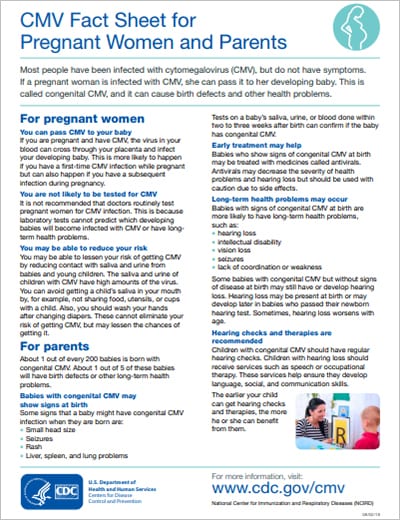
Centers for Disease Control and Prevention (CDC): Resources for Pregnant Women 

Employers:

Occupational Safety and Health Administration (OSHA): "Childcare and healthcare workers are among those at increased risk for exposure to cytomegalovirus (CMV)." See OSHA's  webpage on CMV at: https://www.osha.gov/SLTC/cmv/  

"Occupational exposure to cytomegalovirus (CMV): preventing exposure in child care and educational settings, including OSHA advisories."  Brown, N. J. (2019, November). Occupational exposure to cytomegalovirus (CMV): Preventing exposure in child care and educational settings, including OSHA advisories. Ithaca, NY: Cornell University, ILR School, Workplace Health and Safety Program. Retrieved from:  https://digitalcommons.ilr.cornell.edu/conference/45/  


"Staff Education and Policies on Cytomegalovirus (CMV)," American Academy of Pediatrics, American Public Health Association, National Resource Center for Health and Safety in Child Care and Early Education. (Revised 2017). National Health and Safety Performance Standards: Guidelines for Early Care and Education Programs. Retrieved from Caring for Our Children: http://nrckids.org/CFOC/Database/7.7.1.1. You can download that page as a pdf by clicking on the upper right side of the webpage: "Save as PDF" 

Acceptance of Occupational Risk by Staff Members:  "Each staff member (paid or volunteer) is required to review with a supervisor the following acknowledgment of occupational risk and sign the statement to acknowledge and agree to accept the risk: “I understand there are health risks related to working in child care. These include, but are not limited to, exposure to infectious diseases (including infections that can damage a fetus during a pregnancy)..."
Model Child Care Health Policies (American Academy of Pediatrics, Pennsylvania Chapter, Aronson, SS, ed., 2014, p. 116).   See: http://ecels-healthychildcarepa.org/publications/manuals-pamphlets-policies/item/download/332_de718b5d0a40682caf26b57e9307bc91.html

National CMV Foundation: Educational downloads: https://www.nationalcmv.org/resources/educational-downloads

American Academy of Pediatrics (AAP): According to the AAP, children with known CMV should not be excluded from group care; "CMV excretion is so prevalent that attempts at isolation or segregation of children who excrete CMV are impractical and inappropriate" (Red Book, 2015, pg 145.) Red Book, 2015. Retrieved from: https://redbook.solutions.aap.org/DocumentLibrary/Red%20Book%202015%201.pdf

Centers for Disease Control and Prevention (CDC): Resources for Pregnant Women 

Potential Cost of Not Warning Child Care Providers about CMV

In New South Wales, “a childcare worker and her severely disabled son were awarded $4.65 million. A Court of Appeal ruled that the child's disabilities resulted from the woman being infected with cytomegalovirus (CMV) at work (Hughes v SDN Children's services 2002)” (Queensland Government, Australia, Retrieved from  https://www.worksafe.qld.gov.au/injury-prevention-safety/hazardous-exposures/biological-hazards/cytomegalovirus-cmv-in-early-childhood-education-and-care-services). 

Meridian Lawyers of Australia stated: "The allegations of negligence were that Sydney Day Nursery breached its duty of care to Linda ...by failing to warn her of the risks of CMV in circumstances where the centre knew or ought to have known of the risks of CMV to pregnant women..." Retrieved from: https://www.meridianlawyers.com.au/insights/infectious-diseases-child-care-what-about-staff-members/

Examples of CMV Protocols in Other Countries: 

In Queensland, Australia, suggested control measures include: "relocating workers who are pregnant, or who expect to become pregnant, to care for children aged over two to reduce contact with urine and saliva" (Queensland Government). Retrieved from  https://www.worksafe.qld.gov.au/injury-prevention-safety/hazardous-exposures/biological-hazards/cytomegalovirus-cmv-in-early-childhood-education-and-care-services  

In Germany, to protect day care workers from primary CMV infection, their “CMV serostatus must be checked at the beginning of their pregnancy.” If the worker “is seronegative, she is excluded from professional activities with children under the age of three years” (Stranzinger et al., 2016).  Retrived from: https://www.ncbi.nlm.nih.gov/pmc/articles/PMC4844919/

Notes and additional resources

On May 22, 2019, OSHA announced: "A common virus, Cytomegalovirus (CMV) affects thousands of workers in childcare centers and healthcare facilities. These workers are at the greatest risk of exposure because the virus is often spread through saliva and other body fluids of young children. OSHA's new webpage on CMV [https://www.osha.gov/SLTC/cmv/], explains how to minimize health risks associated with workers' exposure to this virus" ("QuickTakes," OSHA's newsletter on workplace safety and health). 

Managing Infectious Disease - Full Curriculum - Instructor and participant manuals are available through the American Academy of Pediatrics (AAP). Click for Webinar video. See online learning module: https://www.aap.org/en-us/advocacy-and-policy/aap-health-initiatives/healthy-child-care/Pages/Curriculum-for-Managing-Infectious-Diseases.aspx?utm_source=MagMail&utm_medium=email&utm_term=lisasaunders42@gmail.com&utm_content=Healthy%20Futures%20%2D%20MID%20Webinar%203%2E11%2E2020&utm_campaign=Healthy%20Futures%20%2D%20Managing%20Infectious%20Disease%20Webinar

CMV prevention video, "Why Moms-to-be Should Care About CMV" (3:37-minutes): https://youtu.be/OM7WKS7J2mA (content by research nurse, Anna Bartholomew of central Ohio; video by Joel Copeland, Chief Operating Officer of KMI Learning, pro bono, Youtube,  2015).

Utah created English/Spanish brochures specifically for childcare providers:
Connecticut Department of Public Health (CT DPH) website has flyers and information: http://portal.ct.gov/DPH/Family-Health/EHDI/CMV. The National CMV Foundation allowed the CT DPH to embed their logo in their “Are You Pregnant” National CMV Awareness Flyer.
You may wish to distribute the above flyer with this letter from Dr. Brenda Balch on the back:
https://drive.google.com/file/d/1xjQKI8SE1awlHPdD-k27ZwG62W7dnlv3/view?usp=sharing

Letters to medical community:

CT Department of Public Health (DPH) About CMV For Obstetric Health Care Providers and About CMV Testing for Obstetric Health Care Providers.

CT Department of Public Health (DPH) and American Academy of Pediatrics (AAP) About CMV for Pediatric Care Providers. 

Click here to view the National Center for Hearing Assessment and Management (NCHAM) pre-recorded Congenital CMV 101: From Prevention to Treatment webinar or click here for a PDF of the webinar.

For social media, a photo of the flyer will be easier to share. Find the jpeg of “Are You Pregnant” by the National CMV Foundation at:
https://drive.google.com/file/d/1AVG9RXGVsbBTwOImOb18NWDdG3rHbHbm/view?usp=sharing

If you need a pdf of the above flyer with information relevant for childcare providers from CT DPH, then: https://drive.google.com/file/d/0B9Klfxar2CmjemlkcElQQkZfQWs/view)

11. Letter from the Commissioner of Health for New York State, HOWARD A. ZUCKER, M.D., J.D, to "Colleagues". Excerpt: "...Congenital CMV infection is the most common intrauterine infection and the leading non-genetic cause of sensorineural hearing loss in children in the U.S...For all infants, it is critical that healthcare providers include careful follow-up of newborn hearing screen results and ensure subsequent auditory evaluation, when recommended, as a part of routine infant care. For newborns with hearing loss without another etiology, consider evaluation for congenital CMV. However, the majority of infants who ultimately develop congenital CMV-associated sensorineural hearing loss (whether they are symptomatic or asymptomatic at birth) will not have detectable hearing loss during the first month of life. Therefore, efforts aimed at the prevention of CMV infection during pregnancy are key to avoid the significant sequelae of congenital CMV infection, including hearing loss...People who have frequent contact with young children may be at greater risk of CMV infection. CMV can be present in especially high amounts in young children's saliva and urine for months after they become infected. While exposure to CMV may be difficult to avoid, particularly for those who have young children already, it is imperative that we give women of reproductive age the information they need to make informed decisions for themselves and their families.. According to the Centers for Disease Control and Prevention (CDC), female workers of reproductive age in child care centers should be educated on CMV and its potential risks, and should have access to appropriate hygiene measures to minimize occupationally-acquired infection... " https://www.health.ny.gov/commissioner/letters/docs/2018-08.pdf  (August 2018) 

12. Article: "An Often Unknown Cause of Hearing Loss in Children: Understanding and Preventing CMV in the Educational Setting" by Balch, Brenda K., MD, AAP EHDI Chapter Champion for Connecticut (Late Feb 2019). Found at: Supporting Success for Children with Hearing Loss. https://successforkidswithhearingloss.com/wp-content/uploads/2020/02/CMV-An-Often-Unknown-Cause-of-Hearing-Loss.pdf

13.Song for mothers who learned too late about protecting their unborn child from congenital CMV--"Had I Known (about CMV): by Debra Lynn Alt: https://drive.google.com/file/d/0B9Klfxar2CmjRGN0cnBNQXRDdExMQWJOVHVZRGR1aWFJX0lJ/view
14. Article, "The Danger of Spreading CMV: How We Can Protect Our Children" by Lisa Saunders published by ChildCare Aware of America (June 2017).

15. Article, “Help Childcare Providers Fight CMV” by Lisa Saunders published by National CMV Foundation (March 5, 2018)

16. Daycare.com: Cytomegalovirus webpage:  https://www.daycare.com/fastfacts/illness/cytomegalovirus.html

Other ideas:

Check your state’s childcare care licensing department, department of health, department of labor, and local universities with occupational medicine and public health programs. CMV is a bloodborne Pathogen. See Occupational Safety and Health Administration (OSHA) for bloodborne pathogens: https://www.osha.gov/OshDoc/data_BloodborneFacts/bbfact01.pdf  

Potential Cost of Not Warning Child Care Providers about CMV
In New South Wales, “a childcare worker and her severely disabled son were awarded $4.65 million. A Court of Appeal ruled that the child's disabilities resulted from the woman being infected with cytomegalovirus (CMV) at work (Hughes v SDN Children's services 2002)” (Queensland Government, Australia). Meridian Lawyers stated: "The allegations of negligence were that Sydney Day Nursery breached its duty of care to Linda ...by failing to warn her of the risks of CMV in circumstances where the centre knew or ought to have known of the risks of CMV to pregnant women..."

Actions to consider:

1) Childcare providers are typically trained in first aid, CPR, and other topics. CMV prevention should be included in training about preventing infectious diseases. NAEYC (National Association for the Education of Young Children) includes "a. steps to reduce occupational hazards such as infectious diseases (e.g., exposure of pregnant staff to CMV…” 

2) Give each childcare employee/volunteer a CMV brochure (see Utah's brochure for childcare providers). 

3) CMV prevention added to a childcare center’s handbook. See Staff Education and Policies on Cytomegalovirus(Caring for Our Children, AAP, et al.): "Female employees of childbearing age should be referred to their primary health care provider or to the health department authority for counseling about their risk of CMV infection. This counseling may include testing for serum antibodies to CMV to determine the employee’s immunity against CMV infection...it is also important for the child care center director to inform infant caregivers/teachers of the increased risk of exposure to CMV during pregnancy.” Print "Staff Education and Policies on CMV" by clicking "Save as PDF" at: nrckids.org/CFOC/Database/7.7.1.1 

4) CMV information added to a New Staff Orientation Form. The form should be signed to show the childcare provider read and understood they should consult their healthcare provider about their risk for CMV. See sample wording in Model Child Care Health Policies, which has a sample document to be signed by staff (paid or volunteer) to show “Acceptance of Occupational Risk by Staff Members,” which includes “exposure to infectious diseases (including infections that can damage a fetus during pregnancy)” (American Academy of Pediatrics, Pennsylvania Chapter, Aronson, SS, ed., 2014, p. 116). 

5) The Child Care and Development Block Grant Act of 2014 has created regulatory changes. The Administration for Children and Families published Caring for our Children Basics (based on Caring for Our Children) in 2015 to “align basic health and safety efforts across all early childhood settings." In the section, “Prevention of Exposure to Blood and Body Fluids,” it states: “Caregivers and teachers are required to be educated regarding Standard Precautions [developed by CDC] before beginning to work in the program and annually thereafter. For center-based care, training should comply with requirements of the Occupational Safety and Health Administration (OSHA).”
6) Hang signs about CMV prevention in child care centers so staff and parents can see them (see CMV resources below--for Connecticut DPH logo in the “Are You Pregnant” poster by the National CMV Foundation, click here). Signs in child care centers are important because mothers of young children in group care are also at increased risk for contracting CMV (Pass et al., 1986) and are unaware of this. "Intervening with child care providers and parents through child care facilities are key opportunities to reduce prevalence of CMV infection and other diseases.” (Thackeray and Magnusson, 2016).

7) Consider the protocol posted on the website in Queensland, Australia. They relocate workers who are pregnant, or “expect to become pregnant, to care for children aged over two to reduce contact with urine and saliva.” See their list of safety measures in “Cytomegalovirus (CMV) in early childhood education and care services,” on the Workplace Health and Safety webpage.

8) Examples of CMV Protocols in Other Countries: 
In Queensland, Australia, suggested control measures include: "relocating workers who are pregnant, or who expect to become pregnant, to care for children aged over two to reduce contact with urine and saliva" (Queensland Government). 

In Germany, to protect day care workers from primary CMV infection, their “CMV serostatus must be checked at the beginning of their pregnancy.” If the worker “is seronegative, she is excluded from professional activities with children under the age of three years” (Stranzinger et al., 2016).

Note from me, Lisa Saunders:
I am the leader of the Child Care Providers Education Committee, National CMV Foundation. Using the song,"Had I Known (about CMV)," by Debra Lynn Alt, I created a public service announcement (PSA) on Congenital CMV: Music Video--"Had I Known (about CMV)". The video is geared to those who care for young children. YouTube version at https://youtu.be/1WoGjfieRhY. You are welcome to share this on TV, online, in presentations, etc.


Websites:

For more information on Cytomegalovirus (CMV) and Congenital CMV Infections, visit the Centers for Disease Control and Prevention at https://www.cdc.gov/cmv or the National CMV Foundation at https://www.nationalcmv.org
 Handwashing: Centers for Disease Control and Prevention (CDC) has a video and posters on handwashing procedures and what to do if soap and water are not available: https://www.cdc.gov/handwashing/index.html

Materials produced by the "ChildCare Providers Fighting CMV" project

1) Above-sink wall flyer on hand-washing, "Share a Meal Not the Germs" 
Colored in version of wall sign, "Share a Meal Not the Germs" :

Above-sink wall flyer for hand-washing, "Diaper Wipes Don't Kill CMV"
https://drive.google.com/file/d/1wcGpHOfu3lLKl9vYR_KhI5LIqI_h1tvC/view?usp=sharing

For children to color in version: "Share a Meal Not the Germs":


2) Wall Flyer For Women Who Care for Toddlers: 

3) Fun Teaching Tool Kit for Students and Families: Fairytale tells how to “Share a Meal, Not the Germs.”
Click here for free, two-pages of story and placemat for coloring.  
a. An educational “coloring book, Once Upon a Placemat: A Table Setting Tale by Lisa Saunders and Jackie Tortora. Free pdf version of Once Upon a Placemat: A Table Setting Tale (or the educational fairy tale can be purchased as a bound coloring book, visit Amazon for $5.38). Or, download the words only for a one-page read a loud. OR, READ THE 2ND EDITION IN COLOR. Click here for PowerPoint or pdf. 
b. Placemats: Side one: Placemat with tableware characters with space for your coloring artist's name (perfect for laminating and using as a table-setting reminder): https://drive.google.com/file/d/0B9Klfxar2Cmjd21OTjB6SjNfYVU/view
c. Side two: Germ prevention tips and hand-washing instructions.

5) Book, Help Childcare Providers Fight CMV: People can click here for the free 133-page pdf manuscript or at:

6) PowerPoint Presentation:" Help Childcare Providers Fight CMV": Available as:

c. YouTube Presentation by Lisa Saunders: https://youtu.be/dDkICFULA7M
7) Warning Photograph for Wall/Sharing on Social Media:

Suggested lesson plan for children

Staff can work into STEAM (science, technology, engineering, art and math) theme*


Read aloud the fairytale, "Once Upon a Placemat: A Table-Setting Tale," then share a meal together (see author introduce the story here or on YouTube). Help the children wash their hands and set their place setting by referring to the tableware characters. You can say things like, "remember, Mr. Knife is afraid the dish will run away with the spoon, so put his teeth toward Mr. Plate" and "Miss Cup hates it when people share her without giving her a bath first because of those naughty germs." 

If possible, give each child a "share a meal, not the germs" picnic kit with these suggested items:  

  • Bag (paper or reusable insulated bag).
  • Plate, cup, napkin, fork, spoon, knife.
  • Crayons or washable markers.
  • Placemat with tableware characters (free pdf for coloring and possible laminating).
  • Picnic food (homemade or prepackaged that would use all utensils, such as peanut butter, crackers, applesauce and cake).
  • Hand sanitizer or sanitizing wipes. 
  • Sink hand-washing sign and tri-fold flyer on CMV prevention to take home (found on congenitalcmv.blogspot.com)
  • Free pdf of story, Once Upon a Placemat: A Table Setting Tale, found at: congenitalcmv.blogspot.com. If funds are available, give a child their own bound copy of Once Upon a Placemat: A Table Setting Tale to color and share with their families so their parents can reinforce the table-setting lesson and learn how to prevent CMV, the #1 birth defects virus, as well as other diseases (book available on Amazon for $5.38). 

*STEAM is a popular way to package and present the interconnectedness of  Science, Technology, Engineering, Art and Math in the regular curriculum. When you talk about germs, the coloring book, “Once Upon a Placemat” (Art and Literacy), introduces germs (science, biology) in a format that integrates the arts.  Drawing and writing activities can be planned to further integrate those domains.  Teachers can further bring in technology and engineering by designing activities that help the children to "invent" equipment or machines to help better wash hands, keep food fresh and germ free, etc.  Math can enter into the plan by graphing how long children wash their hands, how often they wash their hands, keep track how many uses the classrooms get out of a single pump bottle of hand soap, etc. With a little more thought (and a few trips to Pinterest!) lots of germ-based activities can be created and integrated.

ABOUT
Lisa Saunders, Founder of “ChildCare Providers Againt CMV” 
Lisa Saunders, a former licensed childcare provider and graduate of Cornell University, was instrumental in helping Connecticut pass a CMV testing law in 2015. She is the parent representative of the Congenital Cytomegalovirus Foundation, an award-winning writer, and SEC-TV talk show host living in Mystic, Connecticut, with her husband, Jim. She is the content coordinator for the magazine, Groton-Mystic Neighbors, author of 10 books, and a part-time history interpreter at Mystic Seaport.  Lisa writes extensively about congenital CMV in her books and through articles such as "The Danger of Spreading CMV: How We Can Protect Our Children" (ChildCare Aware of America, 2017) and “Help Childcare Providers Fight CMV” (National CMV Foundation, 2018) Lisa's CMV-related books include:

Japan: Elizabeth and Riley the Miracle Dog (Japanese translation of Anything But a Dog! The perfect pet for a girl with congenital CMV). (S. Nakai, Trans.) Tokoyo: Thousands of Books Japan. Retrieved from http://shop.thousandsofbooks.jp/items/5173204


Tuesday, April 3, 2018

June Cytomegalovirus (CMV) Awareness Month. CMV #1 Birth Defects Virus in Childcare Centers. Moms Warn Pregnant Women of Increased Risk with New Book and Song

Attention: June is Cytomegalovirus (CMV) Awareness Month. CMV #1 Birth Defects Virus in Childcare Centers. Moms Warn Pregnant Women of Increased Risk with New Book and Song.

I am hoping the media will take advantage of the upcoming National Cytomegalovirus Awareness Month in June in order to warn women how to prevent the leading viral cause of birth defects.


Congenital (present at birth) cytomegalovirus (CMV) disables 4,000 newborns each year in the U.S, according to the Centers for Disease Control and Prevention (CDC).  Women who care for toddlers are at increased risk for contracting CMV.

CMV in childcare centers is a real problem. According to the March of Dimes, “As many as 7 in 10 children (70 percent) between 1 and 3 years of age who go to day care may have CMV. They can pass it on to their families, caretakers and other children.” Mothers of children in group care  are at increased risk for CMV (Pass et al., 1986) and most childcare providers are unaware they have an occupational risk for CMV (Joseph et al., 2006). 

I was a pregnant licensed childcare provider who didn't know about CMV until after my daughter Elizabeth was born severely disabled by congenital CMV. I helped Connecticut pass a new law effective 2016 aimed at battling CMV (that story was featured in Cornell Alumni Magazine and Connecticut Magazine).

CMV in childcare is a very "inconvenient truth" and I think many in the industry are afraid to alarm their workers. However, a few states such as Utah and Idaho and countries including Germany and Queensland, Australia have worked out a protocol to protect their childcare workers.

I have recently released the book, "Help Childcare Providers Fight CMV" and my friend, singer/songwriter Debra Lynn Alt of North Brandford, CT, is launching a new song, "Had I Known (about CMV)" at the Mystic and Noank Library, CT, on May 9 (details below in my following press release).

Other mothers across the country have gotten CMV laws passed in a few other states, but we need more media attention so women of childbearing age will know how to prevent contracting CMV in the first place. Lack of CMV awareness in the U.S. is due in part to low media coverage according to HealthNewsReview.org in "Why does CMV get so much less news coverage than Zika — despite causing far more birth defects?" (Shipman, 2018). This silence is a problem in regard to prevention, diagnosis and treatment.

Please see my following press release for more information.

Lisa Saunders
Parent representative of the Congenital Cytomegalovirus Foundation.
www.authorlisasaunders.com
PO Box 389, Mystic, CT 06355
LisaSaunders42@gmail.com


CMV: #1 BIRTH DEFECTS VIRUS IN CHILDCARE CENTERS—
MOMS WARN PREGNANT WOMEN OF INCREASED RISK

Book "Help Childcare Providers Fight CMV" by Lisa Saunders of Mystic, CT

Jessica Rachels and Rebekah Hall of “Idaho CMV Advocacy Project" distribute books to childcare centers

New song, "Had I Known (about CMV)" © 2018 DebraSong Publishing of North Branford, CT

Mystic, Conn.-- Mothers of children in group care are at increased risk for cytomegalovirus (CMV) and most childcare providers are unaware they have an occupational risk for CMV. Congenital (present at birth) CMV is the leading viral cause of birth defects.  According to the Centers for Disease Control and Prevention (CDC), congenital CMV disables 4,000 babies each year in the U.S. The March of Dimes states: “As many as 7 in 10 children (70 percent) between 1 and 3 years of age who go to day care may have CMV. They can pass it on to their families, caretakers and other children.”  

Lisa Saunders of Mystic, Connecticut, instrumental in the passages of the 2016 CMV law in Connecticut, just published the book, "Help Childcare Providers Fight CMV," to help educate women who care for children on how to reduce their chances of contracting CMV. Saunders was a licensed childcare provider unaware of her increased risk for CMV until after her daughter Elizabeth was born severely disabled by it in 1989. "Most pregnant women know to avoid dirty kitty litter and mosquito bites to protect their unborn babies from disabilities caused by infections," says Saunders, "but very few know how to prevent CMV, which causes more disabilities than Zika or fetal alcohol syndrome." 

Jessica Rachels of Sandpoint, Idaho, was another childcare provider uninformed of her increased risk for CMV.  Jessica’s daughter, Natalie was born disabled by congenital CMV in 2006.  Rachels is including the book in her outreach efforts (see Fundraiser Sets Sights on CMV Awareness, Malone, 2018).  

The stories of childcare providers Jessica Rachels and Lisa Saunders are told in the first chapter of Help Childcare Providers Fight CMV. For those who don't have time to read the book, moms-to-be can learn about CMV just by clicking on the "Look inside" feature on Amazon and advancing to the Acknowledgements page where they will find the facts:

  • Caregivers of young children are at increased risk for CMV, the leading birth defects virus that disables 4,000 babies each year in the U.S. (CDC).
  • Mothers of children in group care are at increased risk for CMV (Pass et al., 1986).
  • 44 - 100% of two-year-olds in group daycare are excreting CMV (Pass et al., 1986).
  • 8 - 20% of childcare providers contract CMV infection every year (AAP et al., 2011) VERSUS 1-4% in general population (CDC).   
  • Diaper wipes do not kill CMV (Stowella et al., 2014 ).
  • “Women may be able to lessen their risk of getting CMV by reducing contact with saliva and urine from babies and young children. Some ways to do this are: kissing children on the cheek or head rather than the lips, and washing hands after changing diapers. These cannot eliminate your risk of getting CMV, but may lessen your chances of getting it” states the CDC. Download this flyer from the CDC: https://www.cdc.gov/cmv/downloads/pregnant-patients-cmv.pdfhttps://blogger.googleusercontent.com/img/proxy/AVvXsEgRbe48ZeNK27AzGAPnakRyyTIP3JRb6JuPiILtdNJE-fifQEqG4VdpxGjwGE7kdnbuaFPbpJE3mcfYx-Fn5Iu3r16zkbCyKRWxcOoSFb8l5pZHdznTGSxacFTce9dxT2bMdRqpWlG4SWUdM4dW1krF9GvIyOkjpttd_Jbh=s0-d-e1-ft

Help Childcare Providers Fight CMV is dedicated to mothers who find out  too late about CMV and includes the lyrics to the new song, "Had I Known (about CMV)" © 2018 DebraSong Publishing. Debra Lynn Alt of North Branford, Connecticut, performed the song for the first time on the Lisa Saunders Show in March 2018. Alt, a former lead singer for the Rolling Stone Magazine House Band writes songs for causes and books that celebrate life—no matter where the journey leads (debralynnalt.com). Alt will launch her new song "Had I Known (about CMV)", and Saunders her new book, "Help Childcare Providers Fight CMV," in Mystic, Connecticut, on May 9, 2018:

Wednesday, May 9, 3:30 p.m.
"Had I Known (about CMV)": Song and Book Launch
Mystic and Noank Library, 40 Library Street, Mystic, CT 06355
Free and open to the public.
Debra Lynn Alt, a former lead singer for the Rolling Stone Magazine House Band, will perform her new song, "Had I Known (about CMV)." The song conveys how a mother feels when she learns her newborn's disabilities might have been prevented had she known about CMV (cytomegalovirus), the leading viral cause of birth defects--a much greater threat to newborns than Zika. Lisa Saunders, author of  "Help Childcare Providers Fight CMV" will introduce her  new book and discuss how she helped Connecticut become the second state to pass a law aimed at battling CMV.
Light refreshments served. More info about CMV: cdc.gov/cmv.
Visit Debra Lynn Alt at: debralynnalt.com; debrasong@gmail.com
Lisa Saunders at: authorlisasaunders.com or congenitalcmv.blogspot.com

###

About Lisa Saunders: Lisa Saunders, a former licensed childcare provider and graduate of Cornell University, was instrumental in helping Connecticut pass a CMV testing law in 2015. She is founder of the Help Childcare Providers Fight CMV Project and the parent representative of the Congenital Cytomegalovirus Foundation. She is the content coordinator for the magazine, Groton-Mystic Neighbors, author of 10 books, and a part-time history interpreter at Mystic Seaport. An SEC-TV talk show host, Lisa lives with her husband, Jim, in Mystic, Connecticut.  Lisa writes extensively about congenital CMV in her books and through articles such as "The Danger of Spreading CMV: How We Can Protect Our Children" (ChildCare Aware of America, 2017) and “Help Childcare Providers Fight CMV” (National CMV Foundation, 2018) . Visit Lisa at www.authorlisasaunders.com or congenitalcmv.blogspot.com.
Lisa's CMV-related books include:
  1. Anything But a Dog! The perfect pet for a girl with congenital CMV 
  2. Surviving Loss: The Woodcutter’s Tale. 
  3. Once Upon a Placemat: A Table Setting Tale 
  4. Help Childcare Providers Fight CMV
Saunders has a PowerPoint to Help Childcare Providers Fight CMV, which is based on her new book, "Help Childcare Providers Fight CMV: Protect Newborns from #1 Birth Defects Virus." You can access the following elements of her PowerPoint:
a. Slides
b. Handouts
c. YouTube Presentation by Lisa Saunders

People can click here for the free 133-page pdf manuscript. To share the book with others, purchase the bound paperback for $6.13 on Amazon by clicking here.

More info about coloring book, Once Upon a Placemat: A Table Setting Tale
Fun teaching toolkit for students and families: Fairytale tells how to “Share a Meal, Not the Germs.” Once Upon a Placemat: A Table Setting Tale is by Lisa Saunders and Jackie Tortora. Click for here for free pdf version or purchased the bound coloring book to hand out on Amazon for $5.38). Toolkit includes:

About Singer/Songwriter Debra Lynn Alt:
Debra Lynn Alt, a former lead singer for the Rolling Stone Magazine House Band, lives in North Branford, Connecticut, and writes songs for causes and books that celebrate life—no matter where the journey leads. To hear Debra's music or read her work, visit her at debrasong.com or contact her at: debralynnalt.com.

Connecticut's CMV Resources since 2016 CMV Law:
Connecticut Department of Public Health(CT DPH) website has flyers and information: http://portal.ct.gov/DPH/Family-Health/EHDI/CMV. The National CMV Foundation allowed the CT DPH to embed their logo in their “Are You Pregnant” National CMV Awareness Flyer.

More information about Congenital CMV: 
Congenital CMV Disease Research, Clinic & Registry
Gail J Demmler-Harrison, MD, Professor, Pediatrics, Section Infectious Diseases, Baylor College of Medicine, Attending Physician, Infectious Diseases Service, Texas Children's Hospital, CMV Registry, CMV Research and CMV Clinic. The CMV Registry supports CMV research, disseminates information and provides parent support. Visit: https://www.bcm.edu/departments/pediatrics/sections-divisions-centers/cmvregistry and Dr. Demmler-Harrison’s blog at: http://www.texaschildrensblog.org/author/gdemmler/
Contact: cmv@bcm.edu. Information available in Spanish.

About the "Help Childcare Providers Fight CMV" Project:
The mission of the Help Childcare Providers Fight CMV project is to educate U.S. women who care for toddlers on how to reduce the spread of CMV to protect their pregnancies until the medical community makes doing so a “standard of care,” the U.S. government passes a law requiring CMV education, or an effective vaccine becomes available. The Help Childcare Providers Fight CMV project wishes to disseminate materials to daycare directors, families, and policy makers. CMV prevention education is accomplished through workshops, public service announcements, health fairs, books, and writing articles such as, "The Danger of Spreading CMV: How We Can Protect Our Children" published by ChildCare Aware of America (2017).

About The Idaho CMV Advocacy Project:
In 2017, Jessica Rachels, along with another mother,  Rebekah Hall, formed the “Idaho CMV Advocacy Project." Together with Rachel's husband, Patrick Rachels, the group got a new law passed in Idaho requiring its Department of Health and Welfare to provide information on cytomegalovirus “to the public, particularly pregnant women and women who may become pregnant” (see CMV education bill signed by Governor Otter).  June has now also been declared as Idaho's CMV Awareness Month to coincide with National Cytomegalovirus Awareness Month. In honor of Idaho's newly declared awareness month, Rachels and Hall plan to distribute CMV educational materials to childcare centers and Early Head Start programs. Depending on funds available, the women hope to give "Help Childcare Providers Fight CMV" to directors and/or the educational coloring book, "Once Upon a Placemat--A Table Setting Tale," also by Saunders, to staff members so they and their students will learn how to set the table and share a meal, not the germs (see Fundraiser Sets Sights on CMV Awareness, Malone, 2018).  The Idaho CMV Advocacy Project is dedicated to educating Idaho women and families about the risks of Cytomegalovirus (CMV) during pregnancy and prevention strategies. https://idahocmv.com. (For more information, or to help the Idaho CMV Advocacy Project, contact Jessica Rachels and  Rebekah Hall at  Idahocmv@gmail.com).


MEDIA COVERAGE OF LISA’S CMV WORK


Thursday, March 8, 2018

Presentation: Help Childcare Providers Fight CMV--Protect Newborns from ...


Click on the play button and then on the bottom right of your screen, click on "YouTube" to watch it as a larger screen on YouTube. Here is the link to it: https://youtu.be/dDkICFULA7M

This presentation by Lisa Saunders is based on the new book, "Help Childcare Providers Fight CMV: Protect Newborns from #1 Birth Defects Virus" available on Amazon: https://www.amazon.com/Help-Childcare... Handouts for this presentation: https://drive.google.com/file/d/0B9Kl... Slides: Slides:https://drive.google.com/file/d/1NmH8... More Information: Centers for Disease Control and Prevention: https://www.cdc.gov/cmv/index.html Facebook: https://www.facebook.com/CMVinChildCare/ Blog: https://congenitalcmv.blogspot.com/ Contact: LisaSaunders42@gmail.com